

Virtue alone has majesty in death.
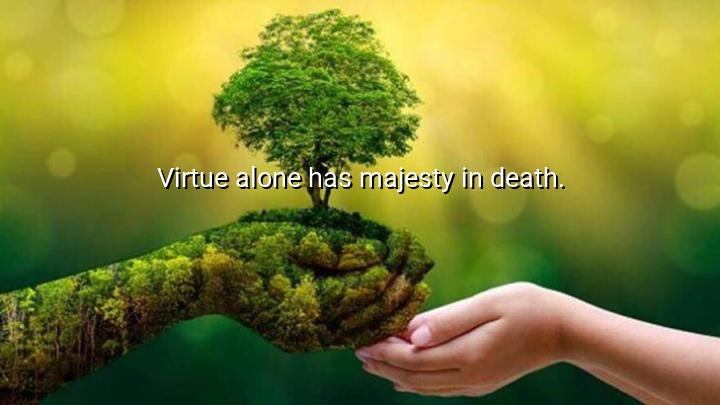




The quote "Virtue alone has majesty in death." by Edward Young suggests that true virtue is the only quality that can give a person dignity and majesty in their final moments, transcending death itself. Young emphasizes that while wealth, power, or fame may fade away or be forgotten after death, the moral integrity and virtue of a person endure. True virtue, according to Young, gives a person a lasting legacy that grants them a sense of respect and nobility even in the face of mortality.
The quote speaks to the idea that moral character and goodness are eternal and cannot be diminished by death. Virtue represents the higher aspects of humanity—honor, honesty, compassion, and integrity—which remain relevant and admired even after one's life ends. Young contrasts this with the fleeting nature of worldly pursuits, suggesting that these do not carry the same weight or significance after death.
In a broader context, the quote also touches on the concept of immortality not through physical or material achievements, but through ethical conduct and how one lives their life. Young highlights that the memory of someone’s virtuous actions can outlive them, offering a form of immortality that is far more enduring than any temporal success. The "majesty" of death, in this sense, refers to the respect and reverence that virtue commands even in the absence of life.
The origin of this quote comes from Edward Young, an English poet and playwright best known for his work Night Thoughts, which reflects on death, immortality, and the human condition. Young's writings frequently explore themes of mortality, suffering, and the pursuit of virtue as a means of attaining eternal significance. This particular quote reflects his deep contemplation on how character and virtue are what truly define a person, transcending the physical limitations of life and death.

HTGia huy Tran
The quote feels powerful and somewhat comforting, suggesting that the quality of one’s character transcends mortality. But I’m left wondering: how do we cultivate such virtue in life, and how do we measure it? Is virtue something innate, learned, or chosen? And what role do external circumstances play in one’s ability to live virtuously? This could lead to a deeper conversation about ethics, free will, and fate.
KHle thi khanh huyen
Reading this, I’m reminded of how different cultures view death and honor. Could Edward Young’s idea be reflecting a Western philosophical tradition, or does it have parallels in other worldviews? I wonder how this concept of majesty linked to virtue compares to ideas of honor in Eastern or indigenous cultures. Would they agree that virtue alone grants majesty, or might other values hold equal or greater importance?
NTBinh Nguyen Thi
This quote sparks a question about the meaning of death and what truly matters at life’s end. Does the author imply that virtue is the only thing that confers honor beyond death? If so, does that mean other qualities—intellect, creativity, courage—are secondary? How do we reconcile this with the multifaceted nature of human greatness? Is it possible that virtue is a necessary foundation, but not the whole story of one’s legacy?
NHHanh Nguyen Hong
The notion presented here intrigues me. How do you interpret 'majesty' in this context? Is it an inner dignity, a kind of spiritual grandeur, or something more tangible like the respect others show? Also, could this perspective be challenged by those who value practical accomplishments or material success? I’d love to explore whether this emphasis on virtue over all else might sometimes overlook complex human realities.
KDKiet Dang
I feel this quote highlights a noble ideal—that integrity and goodness outshine all else when life ends. But I wonder, is it too idealistic? In reality, do people who live virtuously always receive respect and honor in death, or can societal injustices overshadow virtue? It raises a concern: can virtue alone guarantee a legacy of dignity, or must it be accompanied by recognition and remembrance from others?