

To make a prairie it takes a clover and one bee, One clover, and a bee, And revery. The revery alone will do, If bees are few.
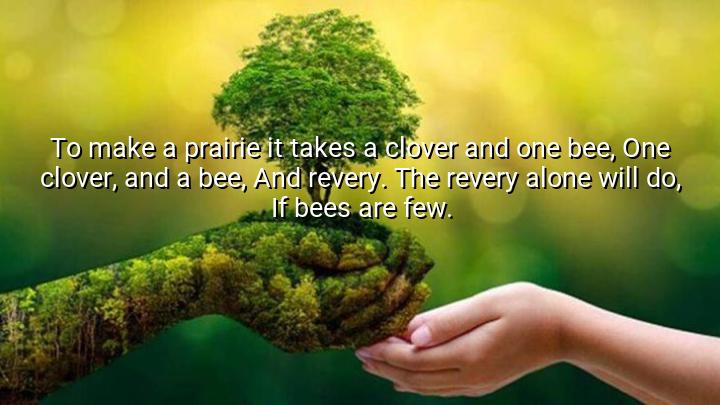




The quote "To make a prairie it takes a clover and one bee, One clover, and a bee, And revery. The revery alone will do, If bees are few" by Emily Dickinson reflects on the power of imagination and solitude in creating a sense of wholeness or beauty. Dickinson suggests that even in the absence of certain elements, like the bees, a single clover—combined with revery (a state of reflective daydreaming)—can still create a prairie, symbolizing the richness that imagination can bring. The idea is that while nature is wonderful in its completeness, the mind's ability to dream and reflect can compensate for what might be lacking in the physical world.
Emily Dickinson, an American poet known for her introspective and unconventional style, often explored themes of nature, solitude, and spirituality. This particular quote encapsulates her belief in the power of the mind to create and appreciate beauty, even in the most solitary or minimal circumstances. Dickinson often found meaning in the small and simple aspects of life, using them to delve into philosophical and emotional reflections.
The phrase "revery alone will do, If bees are few" suggests that even when the physical elements of nature are scarce or absent, the mind's imagination can fill the void. Revery is a state of daydreaming or deep thought, and Dickinson proposes that through reflection and imagination, one can still experience the same sense of wonder or completeness that the actual presence of bees and clovers might provide. This reflects her view that inner life and imagination can be just as significant as the external world.
Ultimately, Dickinson’s quote invites us to consider the richness of imagination and the inner world we create through thought and dreams. It suggests that even when things may seem incomplete or lacking in the physical world, we can still find fulfillment and beauty through our own inner vision. This perspective celebrates the power of the mind and the spirit to shape our experience of the world around us.

CHMinh Chu hoang
This quote really illustrates Dickinson’s genius for capturing emotional truth through nature. The line about revery alone doing the job makes me wonder—how much of our reality is shaped by our internal world? Could this be a metaphor for hope, suggesting that when conditions aren’t perfect, the human spirit can still fill in the gaps with imagination? It’s both inspiring and slightly melancholic.
TTPhan thi Thanh thuy
I find this quote hauntingly gentle. It’s such an optimistic view of solitude and dreaming—that we can still create something meaningful even when circumstances fall short. But it also makes me think: is this idea of 'revery alone' a kind of survival mechanism for people who’ve had to go without? Is Dickinson offering comfort to the lonely or isolated through this metaphor?
NPUyen Dang Nguyen Phuong
This poem feels like a celebration of minimalist wonder and imagination. It suggests that with even the smallest elements, beauty can bloom—especially when aided by the mind’s eye. But I’m curious: does the 'revery alone' imply that human consciousness has creative agency that transcends the physical world? And if so, how does that idea fit with modern anxieties about tangible progress and results?
GHCao Nguyen Gia Hy
I love how Dickinson takes something as vast as a prairie and reduces it to its essence—then offers the idea that thought alone can recreate it. This reminds me of how memory or longing can bring joy or peace in difficult times. But it also raises the question: is that enough? Can mental landscapes really substitute for real-world experiences, or do we eventually need the bee and the clover too?
NTNNgoc Thaoo
There's something deeply comforting about this idea. It speaks to the power of the mind to create beauty, even in the absence of all needed ingredients. But I wonder—does relying too much on imagination risk detachment from reality? Is Dickinson advocating escapism, or celebrating resilience? It’s poetic, sure, but can ‘revery’ alone truly nurture us when the world offers so little?