

I argue thee that love is life. And life hath immortality.
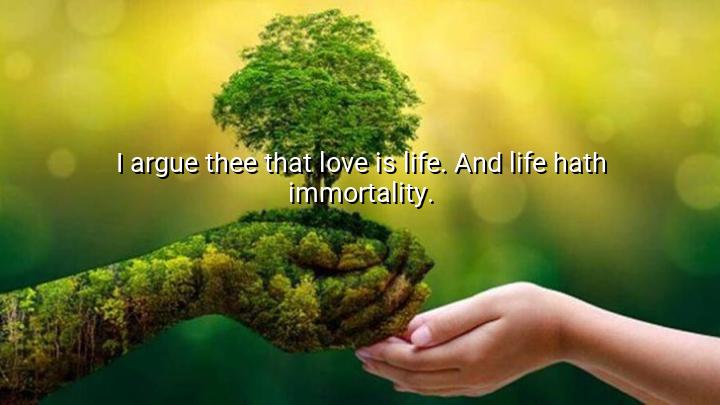




In this quote, Emily Dickinson draws a profound connection between love and life, suggesting that love is not only essential to the experience of living but also imbues life with a sense of immortality. By saying "love is life," she emphasizes that love is a core, sustaining force—what gives meaning and vitality to existence. For Dickinson, love transcends the ordinary and becomes a force that extends beyond time, possibly even beyond death. The phrase "life hath immortality" suggests that through love, human life can achieve a form of eternal significance or continuity, making it feel everlasting even though our physical existence is finite.
Dickinson often explored themes of life, death, and the transcendent in her poetry. This quote reflects her tendency to consider love as a force that transcends the limits of human existence. While the body may decay, the emotional and spiritual essence of love persists. In this way, Dickinson is offering a sense of comfort and hope, implying that love grants something eternal within the otherwise fleeting nature of life.
The origin of this quote can be found within Dickinson’s broader philosophical and poetic explorations of existential questions. Much of her work, which was written in the 19th century but largely published posthumously, revolves around her intimate reflections on mortality and the nature of the soul. She was known for her deeply personal and often mystical poems that questioned the boundaries between life and death, and between the material and spiritual worlds. This quote is a distilled expression of her belief that love is the very essence of life and its enduring legacy.
Ultimately, Dickinson’s quote serves as a reminder of the power of love in shaping our understanding of existence. It suggests that love, in its purest form, can elevate our everyday lives and create a sense of immortality—an enduring connection to others and to the universe. Through love, life becomes something more than just a finite experience; it becomes a continuous, eternal thread that ties us to the past, present, and future.

AAdministratorAdministrator
Welcome, honored guests. Please leave a comment, we will respond soon