

Find ecstasy in life; the mere sense of living is joy enough.
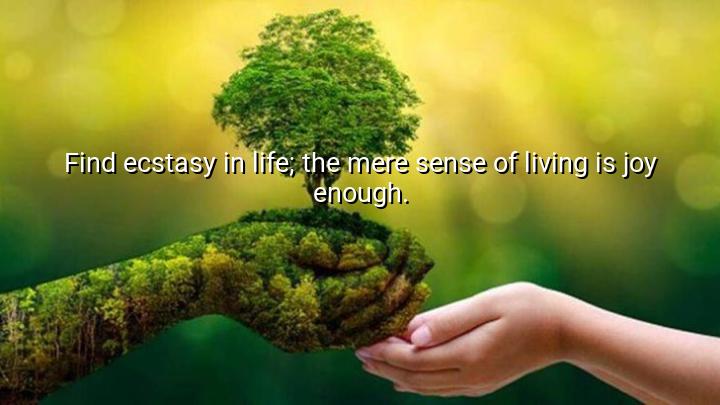




Emily Dickinson’s quote, "Find ecstasy in life; the mere sense of living is joy enough," reflects her belief in the inherent joy and beauty found in the experience of simply being alive. Dickinson urges us to embrace the present moment and recognize that the act of living itself—whether through simple pleasures, connection with nature, or inner peace—is a source of profound ecstasy. Rather than seeking external sources of happiness, she emphasizes that the mere awareness of our existence can bring us deep satisfaction.
The phrase "the mere sense of living is joy enough" highlights a central theme in Dickinson’s poetry: the importance of personal experience and contemplation. She often wrote about finding meaning and beauty in the everyday, celebrating the small, overlooked moments that make life worth living. Her perspective challenges the modern tendency to chase external success or material possessions as the path to happiness. Instead, she suggests that the true joy lies in cultivating a deep appreciation for life itself.
Dickinson’s own life was often marked by solitude and introspection, which may have influenced her view on finding ecstasy in the simplest aspects of existence. She spent much of her time writing in seclusion, contemplating nature, death, love, and the self. Her emphasis on inner joy suggests a philosophy rooted in self-awareness and the celebration of life’s quiet, fleeting moments.
In essence, this quote calls us to embrace mindfulness and find contentment in the present. By tuning into the intrinsic wonder of being alive, we can discover a form of happiness that doesn’t depend on external circumstances or grand achievements. For Dickinson, the greatest ecstasy comes not from seeking something more, but from recognizing the joy that already exists within us and the world around us.

AAdministratorAdministrator
Welcome, honored guests. Please leave a comment, we will respond soon