

The true and solid peace of nations consists not in equality of arms, but in mutual trust alone.
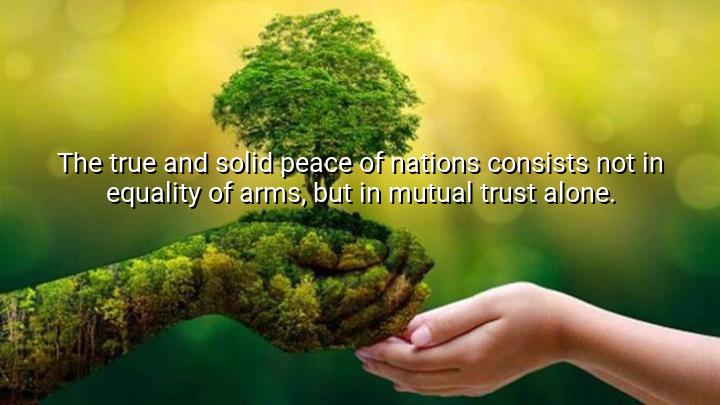




In this quote, Pope John XXIII emphasizes the idea that true peace between nations is not achieved through a balance of military strength or power, but through mutual trust. He argues that while the equality of arms—the idea that nations maintain similar military capabilities—may provide temporary security, it is trust between nations that forms the foundation of lasting peace. This perspective challenges the traditional belief that military might is the primary means of preventing conflict.
Pope John XXIII's statement reflects his broader vision for international relations, where cooperation and understanding between countries are more important than competing for military superiority. By focusing on mutual trust, the Pope is advocating for diplomacy, dialogue, and collaboration as the true paths to peace. Trust, he suggests, allows nations to peacefully resolve conflicts and work together towards common goals, reducing the likelihood of war or aggression.
The quote also addresses the moral and ethical aspects of peace, suggesting that peace built on trust is more sustainable and fulfilling than one based on fear or the threat of violence. Mutual trust requires respect, open communication, and a willingness to cooperate, all of which are essential for maintaining harmonious relationships between countries. This aligns with the Pope’s broader teachings on peace, where he often spoke about the importance of love, understanding, and forgiveness in international affairs.
Ultimately, Pope John XXIII’s quote serves as a call for a shift in how nations approach peace and security. Instead of relying on military force or the balance of power, he advocates for building trust as the essential component of lasting peace. It highlights the idea that true peace is rooted in the human connection between nations, where understanding and collaboration replace fear and confrontation.

VLVinh Le
This quote feels deeply rooted in Christian ethics—love, trust, and reconciliation. But I wonder how it translates into secular or pluralistic contexts where moral frameworks differ. Is mutual trust a universal value, or is it something that must be taught and modeled intentionally through education and international institutions? Peace sounds simple here, but maybe it requires decades of dialogue, transparency, and courage to become real.
Hheo
I appreciate the wisdom here, but I’m also skeptical. Isn’t some degree of military balance necessary to deter aggression from bad-faith actors? What happens when one nation offers trust and the other exploits it? It feels like trust alone isn’t enough unless both sides are genuinely committed to peace. How do we tell the difference between sincere diplomacy and strategic manipulation?
MTNhat Minh Trinh
I find this quote deeply moving. It suggests that peace is more about relationship-building than power-balancing. But how do we encourage mutual trust when so many political systems are driven by nationalism, suspicion, and competition? Should we start by building trust locally—between communities, cultures, and ordinary people? Maybe peace begins from the ground up, not the top down. I wonder what practical steps could bring this idea to life.
NMthang nguyen minh
Reading this, I’m reminded of the Cold War—how the arms race never actually created safety, only tension. Pope John XXIII’s quote seems to advocate for disarmament in favor of human connection. But how realistic is that in today’s climate, where cyber warfare and proxy conflicts dominate? Is there a path to peace that doesn’t rely on the fear of mutual destruction, and can trust really be enough?
HMHang Minh
I love the moral clarity here. It feels like a challenge to the entire idea of peace through military might. But I wonder, is it naïve to expect mutual trust in a world where secrecy and strategic advantage are so deeply embedded in international relations? Does this quote call for a transformation of values on a global scale—where trust is cultivated not just between governments, but between peoples?