

The end of law is not to abolish or restrain, but to preserve and enlarge freedom. For in all the states of created beings capable of law, where there is no law, there is no freedom.
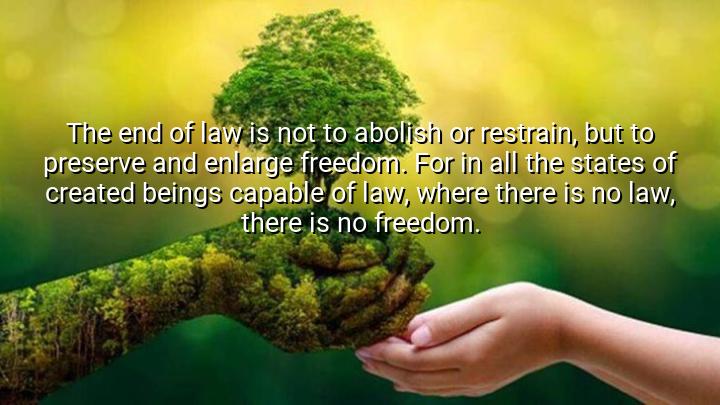




The quote "The end of law is not to abolish or restrain, but to preserve and enlarge freedom. For in all the states of created beings capable of law, where there is no law, there is no freedom." by John Locke reflects one of the foundational principles of liberal political philosophy. Locke argues that the true purpose of law is not to limit individuals arbitrarily but to protect and expand freedom within a structured society. According to him, freedom does not mean living without rules; instead, it means living under just laws that safeguard the natural rights of individuals—especially life, liberty, and property.
This quote originates from Locke’s influential work, Two Treatises of Government (1689), which helped shape the development of modern constitutional democracy. At a time when absolute monarchy was dominant in Europe, Locke’s ideas were revolutionary. He proposed that legitimate government arises from the consent of the governed, and that laws must serve the common good by enabling people to live in peace and security. In this framework, law and liberty are not enemies but allies.
Locke’s phrase “where there is no law, there is no freedom” challenges the idea that anarchy or total individual autonomy leads to genuine liberty. In fact, without laws to protect rights and establish fairness, people would live in constant fear of harm, injustice, and insecurity—conditions that destroy the very essence of freedom. Therefore, law is not a burden but a guarantor of freedom, ensuring that one person's liberty does not come at the expense of another’s.
Ultimately, this quote encapsulates Locke’s enduring influence on democratic societies, particularly on documents like the U.S. Declaration of Independence and the Bill of Rights. His vision of law as a protector of liberty, rather than a tool of oppression, remains central to contemporary understandings of human rights, civil society, and the rule of law. It affirms that freedom, to be meaningful and sustainable, must be rooted in a framework of justice and mutual respect.

AAdministratorAdministrator
Welcome, honored guests. Please leave a comment, we will respond soon