

The improvement of understanding is for two ends: first, our own increase of knowledge; secondly, to enable us to deliver that knowledge to others.
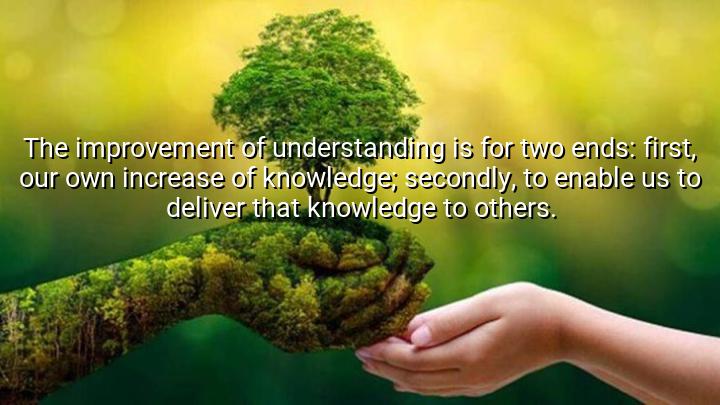




The quote by John Locke, “The improvement of understanding is for two ends: first, our own increase of knowledge; secondly, to enable us to deliver that knowledge to others,” emphasizes the dual purpose of learning. Locke suggests that the pursuit of knowledge is not only for personal intellectual growth but also for the benefit of society. By improving our understanding, we enhance our own insight and become capable of sharing that knowledge to educate, inspire, and assist others.
Locke, a 17th-century English philosopher and political theorist, is often regarded as a foundational figure in empiricism and educational theory. In this quote, he underscores the social responsibility that accompanies learning. True knowledge is not merely accumulated for individual gain; it carries the ethical obligation to share and contribute to the development of others, fostering collective progress.
The origin of this quote lies in Locke’s extensive writings on human understanding, particularly his treatise An Essay Concerning Human Understanding. Locke explored how knowledge is acquired, refined, and communicated, emphasizing both the personal and societal dimensions of intellectual growth. He believed that education and the dissemination of knowledge were crucial for moral and civic development.
Ultimately, Locke’s insight reminds us that the pursuit of understanding has a dual function: self-improvement and societal contribution. By increasing our own knowledge and sharing it with others, we create a culture of learning and progress. The quote highlights that true intellectual growth is both personal and communal, reinforcing the value of education, mentorship, and the responsible use of knowledge.

AAdministratorAdministrator
Welcome, honored guests. Please leave a comment, we will respond soon