

Reading furnishes the mind only with materials of knowledge; it is thinking that makes what we read ours.
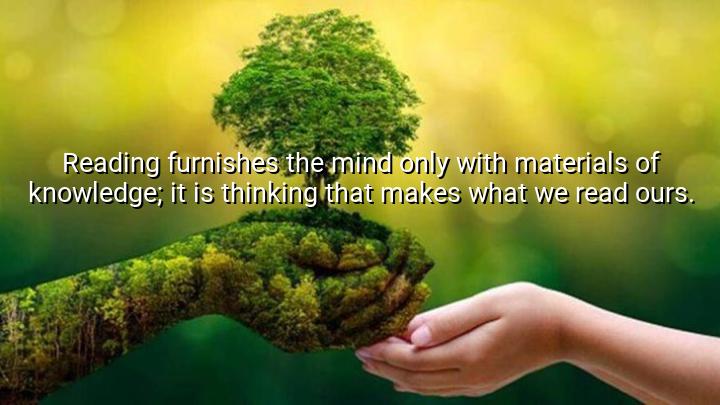




The quote, “Reading furnishes the mind only with materials of knowledge; it is thinking that makes what we read ours,” is attributed to John Locke, a 17th-century English philosopher known as the “Father of Liberalism.” Locke’s works on empiricism and the theory of knowledge emphasized the importance of experience and reflection in shaping human understanding. In this statement, he draws a distinction between the passive act of reading and the active process of thinking, highlighting that true knowledge comes when ideas are critically absorbed and integrated into one’s own understanding.
The first part, “Reading furnishes the mind only with materials of knowledge,” suggests that books and external sources provide raw information, much like bricks for building a structure. However, without reflection, this information remains unprocessed and external. Locke emphasizes that reading alone is not sufficient; it merely supplies the mind with potential tools for growth.
The second part, “it is thinking that makes what we read ours,” stresses the necessity of engaging critically with information. Through analysis, questioning, and reflection, individuals internalize knowledge, making it personal and meaningful. This process transforms borrowed ideas into one’s own intellectual property, allowing for deeper understanding, creativity, and independent thought.
Overall, Locke’s insight aligns with his broader philosophy of empiricism, where knowledge is not innate but developed through experience and reflection. The quote serves as a timeless reminder that true learning is not about memorizing texts but about cultivating the ability to think, reason, and apply ideas to life.

AAdministratorAdministrator
Welcome, honored guests. Please leave a comment, we will respond soon