

Reverie is when ideas float in our mind without reflection or regard of the understanding.
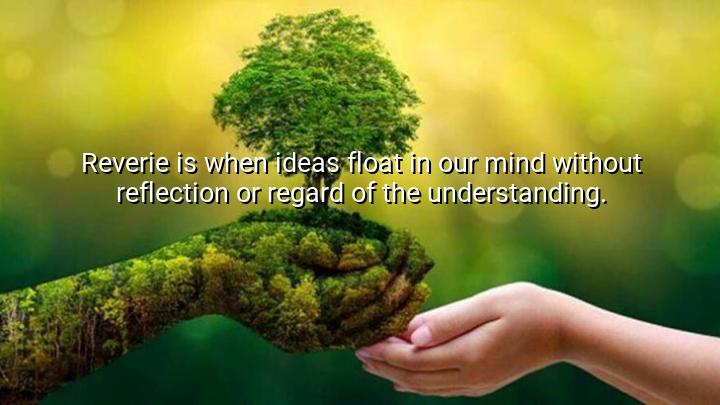




The quote "Reverie is when ideas float in our mind without reflection or regard of the understanding" by John Locke describes the concept of reverie, a state where thoughts and ideas drift through the mind without conscious effort or reflection. Locke is pointing out that in reverie, the mind is not actively engaged in logical or critical thinking. Instead, ideas appear spontaneously and often without the structure or purpose that typically accompanies rational thought. This state is often associated with daydreaming, where the mind wanders freely, disconnected from purposeful or organized thinking.
Locke’s definition of reverie suggests that it is an unconscious, passive process, where ideas come and go without any focus or intentional examination. He contrasts reverie with more deliberate forms of thought, which involve reflection and a considered analysis of the ideas at hand. While reverie can be relaxing or creative, Locke implies that it does not contribute to the kind of understanding or knowledge that comes from active engagement with thoughts.
The origin of this quote can be traced to Locke’s work in philosophy, particularly his explorations of consciousness and the mind. Locke was an influential philosopher in the Enlightenment period, known for his theories on the empirical mind and the nature of knowledge. In his writings, he frequently discussed the difference between active and passive mental states, and this quote is an example of his focus on how the mind works when not intentionally focused on reflection or reasoning.
Ultimately, Locke’s quote draws attention to the idea that reverie is a form of mental relaxation, but it does not lead to the kind of deep insight or understanding that comes from active, intentional thinking. It reminds us that while free-flowing thoughts can be enjoyable or even spark creativity, true knowledge and understanding require more disciplined mental effort and reflection.

AAdministratorAdministrator
Welcome, honored guests. Please leave a comment, we will respond soon