

The best of artists has no conception that the marble alone does not contain within itself.
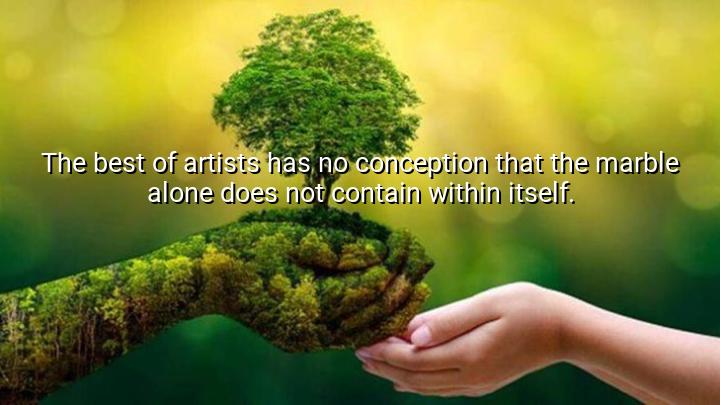




The quote "The best of artists has no conception that the marble alone does not contain within itself" by Michelangelo highlights the idea that true artistry is not about what the medium provides, but what the artist brings to it. Michelangelo suggests that the artist’s vision and skill are essential to unlocking the potential within a material. In this case, he is referring to marble, which, while beautiful and capable of being sculpted, requires the artist’s creativity and effort to reveal its true form.
Michelangelo’s perspective reflects his belief that art is not just about shaping the material, but about perceiving the possibilities within it. This concept can be understood through his own work, such as the renowned David statue. He saw the marble as a canvas where the sculpture already existed, waiting to be uncovered. The artist’s role is to remove the unnecessary parts, revealing the beauty hidden within the raw material.
The origin of this quote lies in the Renaissance period, when Michelangelo was one of the leading figures in the development of Western art. Known for his incredible sculptures, paintings, and architectural works, he believed that the artist’s task was to see beyond the surface and discover what was latent in the material. This mindset transformed the approach to art during his time and continues to influence modern artistic thought.
In essence, the quote teaches that artistry is not just about manipulating materials, but about perceiving their true potential and bringing it to life through vision and creativity.

THDo Thanh Huyen
I find this statement fascinating because it challenges the ego often associated with artistry. Could accepting that the marble holds its form lead to greater respect for materials and process? Does this view also suggest that true art involves listening and patience rather than control? It would be enlightening to discuss how different artists interpret this balance.
VTVn Thanh
This quote invites reflection on the mystery of creation. If the marble ‘contains’ the form, what does that say about the nature of inspiration? Is the artist a conduit rather than an originator? How might this idea influence the way we appreciate art, knowing that what we see is both discovered and shaped?
TVTran Van
Michelangelo’s statement seems to suggest a kind of collaboration between the artist and the material. How does this dynamic shape the final artwork? Does it imply that the artist must be attuned to the innate possibilities within their medium? I’d be interested in exploring how this view impacts artistic training and practice.
XTXuan Toan
Reading this, I’m intrigued by the concept that the best artists don’t force their vision but rather reveal what’s hidden. Could this perspective encourage humility and attentiveness in the creative process? It also makes me wonder how this aligns with modern ideas of originality and artistic ownership. Is creativity less about invention and more about revelation?
QKPhan nguyen quoc khanh
This quote makes me think about the relationship between material and imagination. If the marble already contains the form, what role does the artist play? Is it more about patience, perception, and respect for the medium? How might this idea inform how we approach challenges in creativity or problem-solving in other fields?