

The best artist has that thought alone Which is contained within the marble shell; The sculptor's hand can only break the spell To free the figures slumbering in the stone.
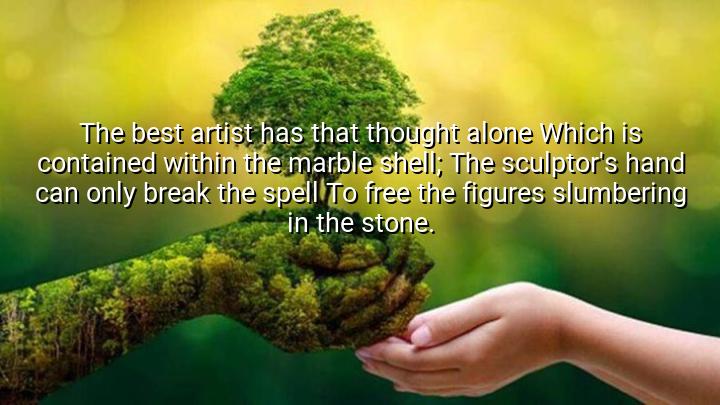




The quote "The best artist has that thought alone Which is contained within the marble shell; The sculptor's hand can only break the spell To free the figures slumbering in the stone" is from Michelangelo, one of the most renowned figures in the Renaissance and a master sculptor, painter, and architect. In this statement, Michelangelo reflects on the nature of creativity and the role of the artist. He suggests that the true art already exists within the medium itself, waiting to be uncovered. The sculptor, in this case, does not impose their vision upon the stone but reveals what is already there, hidden inside.
Michelangelo’s words emphasize the idea that creativity is not about inventing something entirely new but about discovering or liberating the beauty or truth that already exists in the material. The phrase "contained within the marble shell" metaphorically illustrates how the raw material holds within it the potential for artistic expression. The sculptor’s job is not to create from scratch, but to work with the medium in such a way that it reveals its inherent form—in this case, the figure slumbering within the stone.
The idea that the sculptor's hand can only break the spell suggests that the process of creating art is more about removing barriers than adding or constructing something new. The "spell" that needs to be broken is the external layer of the material that hides the figure within. Michelangelo is highlighting the effortless beauty and potential that exist within the material itself, waiting for the artist to unveil it. This approach requires deep insight and skill, as the artist must perceive what is hidden and how to bring it forth without destroying the integrity of the material.
In essence, Michelangelo’s quote reflects a profound understanding of artistic creation. It positions the artist not as a creator ex nihilo (out of nothing), but as a revealer of the truth within the material, whether it be stone, paint, or any other medium. This insight into the nature of artistic process underscores the idea that true art comes from awareness and sensitivity to the form that already exists, allowing the artist to simply free it.

HTngo ngoc hong thuy
The metaphor here is so powerful—it almost makes me feel like Michelangelo believed his role was to serve the stone rather than dominate it. Could this be a broader lesson on how we approach problems or relationships in life? That maybe our job isn’t to impose but to uncover what’s already there with care and patience? It’s a humbling thought that art mirrors life that closely.
TBUong Thanh Binh
This quote raises an interesting question about artistic control. If the figure is already in the stone, does that mean the artist is bound to what’s 'meant' to be, rather than creating freely? Is there room for improvisation, or is true artistry about surrendering to something greater than your own will? I love this tension between mastery and humility—it feels deeply spiritual.
TNTruc Nguyen
I’m fascinated by how this quote reframes the artist’s job—not as a maker, but as a discoverer. It makes me wonder about the limits of skill versus perception. Can technical brilliance alone ever compensate for the lack of vision? Maybe that’s what separates good artists from great ones: the ability to 'see' what’s hidden and then patiently coax it into the world without distorting it.
TLMinh Uyen Tran Lam
There’s something almost mystical in this imagery. It’s like the artist is more a conduit than a creator, someone who sees what others can't. Do you think this vision is something you're born with, or can it be cultivated? Is every artist unlocking their own version of truth hidden inside the medium, or is the medium revealing something about the artist in return?
MSTrinh Pham Mai Suong
This quote makes me think deeply about the nature of creativity. Michelangelo seems to be saying that the artwork already exists, and the artist’s role is to reveal it—not invent it. Is this about intuition or spiritual insight? I wonder if this applies only to physical sculpture or if all creative acts are acts of uncovering something that was already there, just waiting to be seen.