

Take up one idea. Make that one idea your life - think of it, dream of it, live on that idea. Let the brain, muscles, nerves, every part of your body, be full of that idea, and just leave every other idea alone. This is the way to success.
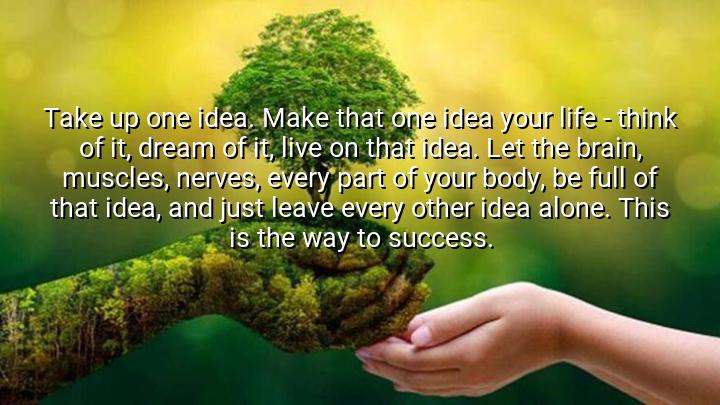




The quote "Take up one idea. Make that one idea your life - think of it, dream of it, live on that idea. Let the brain, muscles, nerves, every part of your body, be full of that idea, and just leave every other idea alone. This is the way to success" by Swami Vivekananda emphasizes the power of focus and dedication in achieving success. Vivekananda advocates for a single-minded pursuit of one goal or idea, suggesting that concentration on that idea should permeate every aspect of your being—thoughts, actions, and physical energy. By eliminating distractions and dedicating yourself completely to one purpose, you maximize your potential and move closer to success.
Swami Vivekananda, an Indian philosopher and spiritual leader, was a key figure in introducing Indian philosophies such as Vedanta and Yoga to the Western world. He emphasized the importance of self-discipline, personal growth, and the power of the mind. This quote reflects his belief in the transformative power of focus and the necessity of pursuing one’s goals with relentless commitment.
The phrase "every part of your body, be full of that idea" highlights how complete dedication can affect not only your mental state but your physical energy and effort. It suggests that true success requires total immersion in your goal—body, mind, and spirit. Vivekananda’s idea is that passion and focus must transcend mere thought, becoming an integral part of your daily actions and being.
Ultimately, the quote is a call to eliminate distractions and devote yourself fully to your vision. Vivekananda teaches that true success comes from unwavering commitment to one goal, where every action is aligned with that purpose. The deeper the focus, the greater the chance of accomplishing meaningful achievements.

NLTrinh Ha Ngoc Linh
This quote reminds me of flow state—when you’re so deeply immersed in a pursuit that everything else fades away. But I wonder: does success only come to those who isolate one idea and push out all others? What about people who thrive through exploration and cross-disciplinary thinking? Can success also emerge from flexibility and curiosity, not just unwavering focus? It feels like both paths should have room in the conversation.
AAn
It’s interesting how this quote frames success as a kind of monastic devotion to an idea. I can’t help but think about artists, scientists, and entrepreneurs who really did live like this. But how do we reconcile this with the growing emphasis on work-life balance and mental wellness? Can the pursuit of success this way be healthy, or is it inherently sacrificial?
AAn
This quote feels very relevant in an age of distractions. We’re constantly pulled in a million directions—notifications, responsibilities, new ideas. Maybe Vivekananda is advocating for mental discipline in a world that rewards scattered focus. But is it realistic today to live with that kind of singular devotion? I’d love to hear from someone who’s actually tried this approach. Did it lead to fulfillment or frustration?
ATAi Tam
There’s something both beautiful and terrifying about this philosophy. The idea of embodying one purpose so completely sounds like a recipe for greatness—but also potential obsession. Is there room for balance in this mindset? Or does true success, as defined here, require sacrificing everything else? I wonder how people maintain relationships, health, or even curiosity about other things when they’re that devoted to a single pursuit.
DHDinhnhan Ho
I find this quote incredibly motivating. It speaks to the kind of single-minded devotion that has probably driven the greatest inventions and breakthroughs. But how do you know which idea is worthy of that level of commitment? What if you choose wrong? This makes me think about the pressure of choosing 'the right path' and how scary it can be to go all in without certainty.