

Take a course in good water and air; and in the eternal youth of Nature you may renew your own. Go quietly, alone; no harm will befall you.
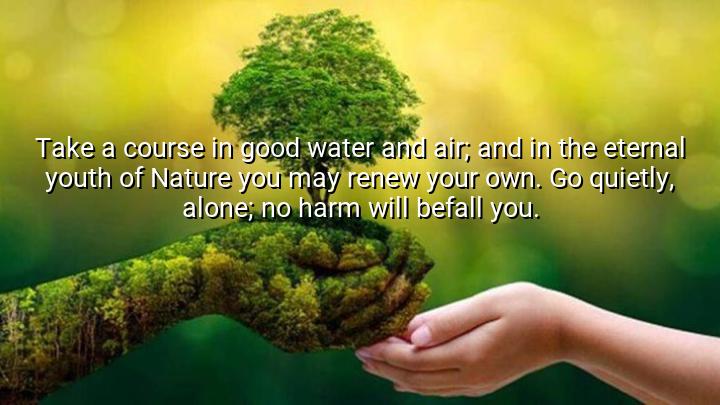




The quote, "Take a course in good water and air; and in the eternal youth of Nature you may renew your own. Go quietly, alone; no harm will befall you," is from John Muir, a Scottish-American naturalist and environmentalist, widely known as the "Father of the National Parks." In this statement, Muir is encouraging people to reconnect with the natural world, suggesting that spending time in Nature, particularly in its purest forms like water and air, can have a restorative effect on one's mind and spirit.
Muir emphasizes the rejuvenating power of Nature, describing it as eternal and ever-renewing. By immersing oneself in the freshness of natural elements, such as clean water and crisp air, an individual can experience a sense of renewal and revitalization. Muir’s philosophy suggests that the natural world has a healing quality that restores balance and energy to those who seek it out, offering a contrast to the stresses and artificiality of modern life.
The idea of going "quietly, alone" underscores the importance of solitude and mindfulness when experiencing Nature. Muir advocates for a peaceful, solitary journey where one can fully absorb the beauty and tranquility of the natural world without distractions. The suggestion that "no harm will befall you" highlights the safety and peace found in Nature, emphasizing that being in tune with the environment brings inner calm and strength, rather than danger.
Ultimately, Muir’s quote reflects his deep belief in the transformative power of Nature. He encourages individuals to step away from the noise and chaos of daily life, find solitude, and embrace the simplicity and purity of the natural world to restore their own sense of well-being. His message continues to inspire people to seek connection with the environment, reminding us that through Nature, we can find peace and renewal.

THNguyen Thanh Ha
This statement evokes a serene image of renewal through natural elements. However, I’m curious how urban dwellers with limited access to ‘good water and air’ might relate to this. Is it possible to find similar renewal within city environments, or does the quote emphasize an essential need for wilderness? Also, how do we reconcile this ideal with environmental crises that threaten the purity of nature’s resources?
VLVy Luong
Reading this, I feel invited to slow down and appreciate simplicity. Yet, I wonder about the challenges of solitude. Is ‘no harm will befall you’ a literal promise, or does it speak to a deeper sense of trust in nature? How does this perspective align with indigenous or traditional views on nature’s role in wellbeing? I’d like to explore how this advice might translate into modern lifestyle changes that promote balance and health.
GDGold D.dragon
This quote inspires me to consider the timeless relationship between humans and the natural world. How does exposure to fresh air and water actually contribute to ‘renewal’—is it physical, emotional, or spiritual? I’d be curious to know if there’s scientific evidence supporting this idea, or if it’s purely poetic. Also, what might ‘eternal youth of Nature’ symbolize beyond just the environment—could it be about resilience or continuity?
TNtien nguyen
I love the peaceful invitation in this statement. It prompts me to think about the role of nature in mental and physical health. But what does ‘go quietly, alone’ really mean in today’s noisy, crowded world? Is solitude in nature accessible to everyone, or does it require privilege and opportunity? Also, could there be risks in isolation, or is the reassurance of safety a metaphor for spiritual renewal?
DNMai Lan Dinh Ngoc
This quote makes me feel a deep longing for nature’s healing power. In our fast-paced, technology-driven lives, how often do we truly pause to immerse ourselves in pure air and water? I wonder if solitude in nature is really as safe and nurturing as suggested, or if it’s a challenge that requires courage. Could this idea also highlight how disconnected we’ve become from the environment and ourselves?