

Bread without flesh is a good diet, as on many botanical excursions I have proved. Tea also may easily be ignored. Just bread and water and delightful toil is all I need - not unreasonably much, yet one ought to be trained and tempered to enjoy life in these brave wilds in full independence of any particular kind of nourishment.
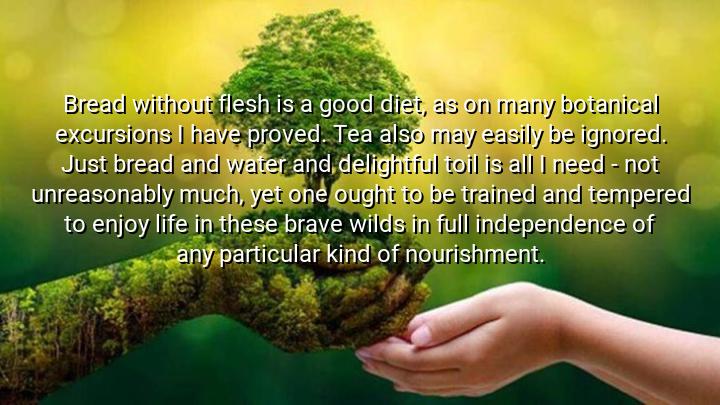




The quote "Bread without flesh is a good diet, as on many botanical excursions I have proved. Tea also may easily be ignored. Just bread and water and delightful toil is all I need - not unreasonably much, yet one ought to be trained and tempered to enjoy life in these brave wilds in full independence of any particular kind of nourishment" by John Muir reflects his minimalist and nature-focused approach to living, especially in the wilderness. Muir, known for his explorations of the wild and his love for the outdoors, emphasizes the simplicity of a basic diet—just bread, water, and the physical activity of toil (work or exertion)—as enough for sustaining himself during his travels in nature.
Muir’s mention of bread without flesh underscores his preference for a vegetarian diet, one that does not rely on animal products. By saying tea may be ignored, he further simplifies the idea of nourishment, focusing only on the most basic elements of sustenance. For Muir, the physical act of being in nature and working with his hands provides him with a sense of fulfillment, demonstrating that he can thrive without the need for excessive or elaborate food choices. The notion of "delightful toil" suggests that the effort of being active in nature is not just physically nourishing but also spiritually satisfying.
Muir also touches on the concept of independence from the usual comforts and luxuries of modern life, especially in relation to nourishment. By suggesting that one should be "trained and tempered" to enjoy life with minimal food, Muir advocates for self-sufficiency and the ability to adapt to simpler ways of living, particularly in the wilderness. His ideal of enjoying life in the "brave wilds" without dependence on any specific kind of nourishment highlights his belief in the value of resilience, freedom, and connection to nature.
Ultimately, Muir’s quote encapsulates his philosophy of simplicity, independence, and harmony with nature. For him, true freedom comes from relying on the most basic forms of sustenance and being in tune with the natural world, rather than depending on elaborate diets or comforts. His words inspire a mindset that values the experience of nature over material needs, emphasizing how one can live fully and independently with minimal reliance on external provisions.

AAdministratorAdministrator
Welcome, honored guests. Please leave a comment, we will respond soon