

Self-reverence, self-knowledge, self-control; these three alone lead life to sovereign power.
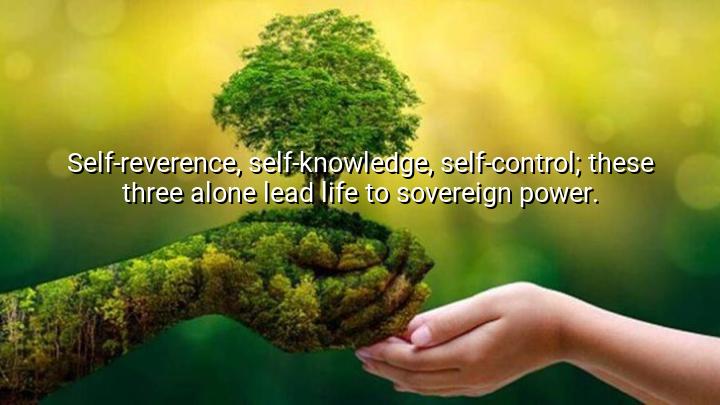




The quote "Self-reverence, self-knowledge, self-control; these three alone lead life to sovereign power" by Alfred Lord Tennyson emphasizes the importance of mastering oneself in order to achieve personal power and fulfillment. Tennyson suggests that the path to a sovereign or empowered life lies in cultivating three key qualities: self-reverence (respect for oneself), self-knowledge (understanding oneself), and self-control (the ability to regulate one’s actions and impulses). These attributes, according to Tennyson, form the foundation of a life of strength and autonomy.
Alfred Lord Tennyson, an English poet and the poet laureate during much of Queen Victoria’s reign, often explored themes of moral integrity, self-discipline, and the quest for meaning in his work. This quote reflects Tennyson’s belief in the transformative power of inner mastery. Through his poetry, Tennyson consistently conveyed the idea that personal growth and self-awareness were essential to living a meaningful and influential life.
The phrase "self-reverence" emphasizes the importance of holding oneself in high regard—respecting one’s own worth and dignity. "Self-knowledge" involves a deep understanding of one’s strengths, weaknesses, and motivations, which is essential for making wise decisions. Finally, "self-control" refers to the ability to manage impulses and act with discipline, which is key to navigating challenges and maintaining personal integrity.
Ultimately, Tennyson’s quote suggests that achieving sovereign power—a life of true autonomy and purpose—requires an unwavering commitment to self-mastery. By developing self-reverence, self-knowledge, and self-control, an individual can achieve the clarity and strength necessary to steer their own course in life, unaffected by external pressures or distractions. It is through these qualities that one can truly find empowerment and freedom.

QNQuynh Nhu
There’s a kind of stoic wisdom in this quote that I admire. It reminds me of philosophies like those of Marcus Aurelius or the Bhagavad Gita. But what does 'sovereign power' mean in this context? Is it dominance, leadership, inner peace, or mastery over the self? I think the meaning changes depending on your worldview. I’d be interested in exploring how different cultures interpret this triad.
KLKieu Linh
This quote strikes me as a personal code of ethics. But I’m wondering if these three traits are equally accessible to everyone. Can someone raised in chaotic or abusive environments, who’s never been taught to value themselves or regulate emotion, be expected to reach 'sovereign power'? Or does the path toward these virtues require privilege or mentorship? It raises questions about nature, nurture, and self-actualization.
THVu Trong Hau
Tennyson’s words are powerful, but I’m curious—what happens if one of these elements is missing? For instance, what if someone has strong self-control and self-knowledge but lacks self-reverence? Would their power be hollow or misdirected? It makes me think about how these traits don’t just stand alone but interact. Maybe it’s the harmony between them that really creates lasting impact.
APTuan Anh Pham
This quote made me pause and reflect. It’s empowering, yes, but also demanding. In a society that often values speed, convenience, and constant validation, how realistic is it to expect people to embody all three of these virtues? Is this a standard reserved for sages and philosophers, or can anyone realistically strive for such balance today? I’d be interested in hearing how others practice these in everyday life.
NNNgoclien Ng
There’s something noble and ancient in the way Tennyson frames self-discipline as a path to greatness. But how do you even begin cultivating self-reverence in a world that often teaches self-criticism? I understand self-knowledge and self-control conceptually, but self-reverence feels abstract. Is it the same as self-love, or something more like moral integrity? I'd love to hear interpretations on what that first principle really entails.