

Pray that your loneliness may spur you into finding something to live for, great enough to die for.
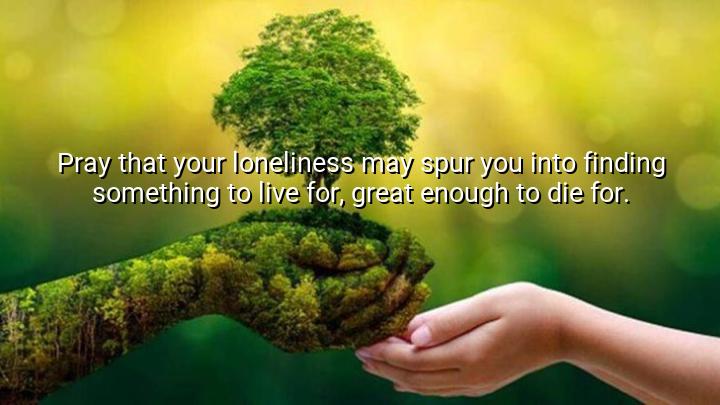




The quote "Pray that your loneliness may spur you into finding something to live for, great enough to die for" by Dag Hammarskjöld speaks to the transformative potential of loneliness. Rather than viewing it purely as a painful or empty experience, Hammarskjöld encourages us to see loneliness as a powerful inner force—one that can push us toward discovering meaning, purpose, and devotion. In this view, loneliness is not something to escape, but a deep call to action and self-discovery.
Dag Hammarskjöld was a Swedish diplomat, writer, and the second Secretary-General of the United Nations. He was widely admired for his integrity, spiritual depth, and moral clarity. Much of his inner life and philosophy is captured in his posthumously published diary, Markings, from which this quote originates. In it, Hammarskjöld often reflected on the intersection of faith, solitude, and service, drawing from both Christian mysticism and personal contemplation.
The phrase “something to live for, great enough to die for” emphasizes the need for a purpose that transcends self-interest—a cause or ideal that gives life value even in the face of suffering or sacrifice. Hammarskjöld suggests that loneliness can act as a spiritual compass, directing us toward that deeper mission or calling. Instead of being consumed by isolation, one can be inspired by it to seek something truly noble and enduring.
Ultimately, this quote is a profound reminder that even in our lowest moments, there lies an opportunity for transformation. Hammarskjöld challenges us to allow loneliness to become not a weakness, but a motivation—to search for meaning so compelling that it shapes the course of our lives. In doing so, we not only rise above solitude but grow into a life of courage, purpose, and conviction.

HTNguyen Huyen Trang
This quote really reframes loneliness as potential, which I love. But I wonder, does everyone get the chance to find a purpose that powerful? Sometimes people are so overwhelmed by loneliness that even imagining something worth dying for feels impossible. What steps can we take to move from pain to purpose in a realistic, compassionate way? I think that’s a question worth exploring, especially in a world with growing emotional isolation.
HQDo Hong Quan
I find this quote beautiful but slightly overwhelming. It implies that suffering can drive us toward something profound, which is empowering. But what if that pressure to find ultimate purpose just adds to someone’s despair? Not everyone is ready to transform their loneliness into fuel. I think the journey to purpose can be slow and non-linear. Shouldn’t we also allow space for gentler, less heroic forms of healing and meaning-making?
DADang Duc Anh
This quote stirs a lot of emotion in me. It makes me wonder if loneliness is actually a kind of spiritual hunger—a longing for meaning, not just company. But I also worry that setting such a high bar for purpose might leave people feeling inadequate if they haven’t found their 'great enough to die for' mission yet. Can something be meaningful without being monumental? Does quiet passion count too?
HPHo Phat
There’s something deeply motivating about this quote. It reframes loneliness not as something to escape, but as a catalyst for transformation. But it also raises a question for me: how do we recognize the right thing to live for? With so many distractions and obligations in life, finding something that stirs the soul that deeply isn’t easy. What if loneliness lingers because we haven’t yet discovered what truly moves us?
GHLe Gia Huy
This quote feels incredibly noble, but also really intense. I admire the idea of turning loneliness into purpose, but I’m curious—does everyone need a cause 'great enough to die for' in order to live meaningfully? Isn’t that standard a little daunting? What if someone just wants to live for the small joys—family, art, growth? I wonder if the quote overlooks quieter forms of meaning that are no less valid or profound.