

Forgiveness is the answer to the child's dream of a miracle by which what is broken is made whole again, what is soiled is made clean again.
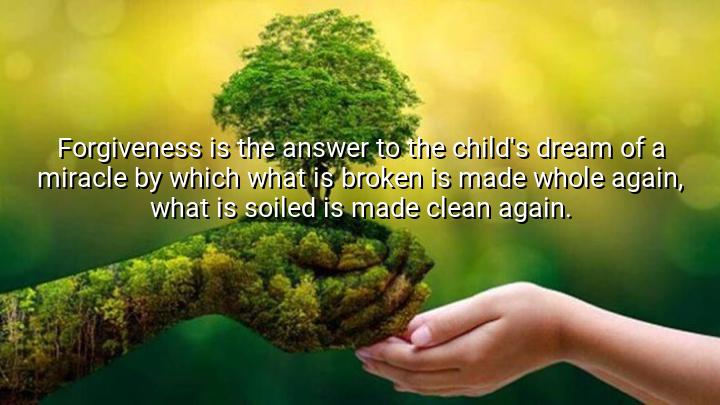




In this quote, Dag Hammarskjöld explores the deep, transformative power of forgiveness. He likens it to a child’s dream of a miracle, where something that is broken is restored to its original state, and something that is soiled is cleansed. Hammarskjöld suggests that forgiveness offers a kind of healing that allows people to move beyond their mistakes or hurt and find restoration—both in their relationships and within themselves.
Hammarskjöld’s comparison to a child's dream emphasizes the almost magical or miraculous nature of forgiveness. In many ways, forgiving someone, or being forgiven, can feel like an act that undoes the damage caused by past actions, much like the fulfillment of a fantastical wish. This idea reflects a profound hope that through forgiveness, individuals can reconcile, finding peace and starting anew, even after experiencing pain or betrayal.
The origin of this quote reflects Hammarskjöld’s personal philosophy as a diplomat, author, and former UN Secretary-General, who worked extensively to resolve conflicts and promote peace during his career. His belief in the power of forgiveness as a tool for reconciliation and healing aligns with his commitment to diplomacy, understanding, and human connection. Hammarskjöld understood that true peace comes not only from solving external problems but also from internal healing, which is often achieved through forgiving.
Ultimately, Hammarskjöld’s quote emphasizes that forgiveness is not just an act of letting go, but a miraculous process of making things whole again. It calls attention to the transformative and restorative power of forgiving, both for the person who offers it and for the one who receives it. Through forgiveness, the broken can be repaired, and the soiled can be cleansed, leading to true healing and reconciliation.

AAdministratorAdministrator
Welcome, honored guests. Please leave a comment, we will respond soon