

Plant and your spouse plants with you; weed and you weed alone.
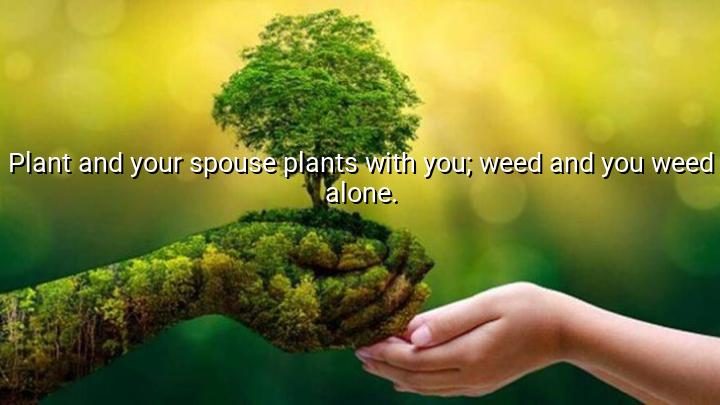




In this quote, Jean-Jacques Rousseau reflects on the dynamics of relationships and the idea of shared efforts versus individual responsibility. The first part, "Plant and your spouse plants with you," suggests that positive actions, growth, and ambitions are often collaborative efforts. When we engage in building something meaningful, such as a family, a project, or a shared life, we do so together with those we love and care for. This creates a sense of partnership and mutual support, where both individuals contribute toward achieving common goals.
The second part, "weed and you weed alone," contrasts this by suggesting that when it comes to challenges, problems, or the more difficult and unglamorous tasks in life, one often faces them alone. Weeding can be seen as a metaphor for dealing with difficulties, hardships, or the more tedious aspects of life, which, according to Rousseau, are primarily the responsibility of the individual. Even though a person may have support during moments of growth or success, during moments of struggle, they often feel isolated or alone in facing their personal battles.
Rousseau’s quote speaks to the nature of human relationships, suggesting that while love and companionship provide support in many aspects of life, the burden of personal hardship often falls on the individual. It emphasizes both the shared joy and the solitary nature of life's challenges, reminding us that while we might have support during the good times, we must often endure and resolve our difficulties on our own.
Ultimately, Rousseau’s words reflect the duality of relationships: they can provide deep connection and support, yet individuals must also be prepared to face their personal struggles. The quote encapsulates the balance of interdependence and individuality, suggesting that while the positive moments in life are best enjoyed together, personal growth and facing adversity often require internal strength and solitude.

BHTRAN BAO HAN
I read this as a quiet warning: that joy and progress often attract company, while struggle and correction isolate us. That’s tough, especially in intimate relationships where you'd expect mutual effort. But I wonder—could the act of weeding alone sometimes be necessary for personal growth? Maybe some battles aren't meant to be shared. Does this quote devalue solitude and reflection, or just point out the imbalance in shared responsibilities?
BTMai Tram Bao Tram
The metaphor here is powerful. Planting is hopeful, forward-looking, and full of promise, while weeding is laborious and repetitive. It makes sense why people prefer one over the other. But shouldn't love—or partnership—mean being present for both? It makes me ask: what kind of emotional maturity or communication is required to make that happen consistently? Maybe it’s not just about shared action, but shared values and resilience.
NTNam Tran
I can’t help but think of this in the context of parenting or shared projects. So often, we’re quick to celebrate successes together, but blame and problem-solving fall on fewer shoulders. Is that human nature, or do we need to be more intentional about fairness? What can we do to make sure both the planting and the weeding are truly collaborative? I’d love to hear strategies that have worked for others.
VT7D6 Nguyen Van Tay
This quote feels a bit cynical to me. Is it fair to assume that spouses—or anyone close to us—won’t help us through the challenges? I know people who stick by each other through weeding and storms. Maybe Rousseau had a particular view of human nature, but it seems to generalize too much. What if the quote says more about his personal disappointment than about relationships in general?
DHDO HAI
There’s something deeply melancholic in this statement. It makes me wonder: do we really abandon each other when things get tough, even in supposedly committed relationships? Or is this more about emotional responsibility—like weeding refers to inner work no one else can do for you? Either way, it raises questions about mutual support and accountability. Can a healthy partnership truly exist if burdens are carried solo while rewards are shared?