

Only that thing is free which exists by the necessities of its own nature, and is determined in its actions by itself alone.
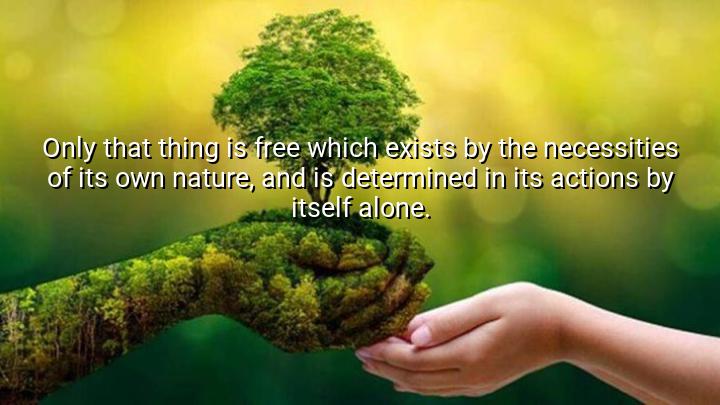




The quote "Only that thing is free which exists by the necessities of its own nature, and is determined in its actions by itself alone." by Baruch Spinoza reflects his philosophical view on freedom and determinism. Spinoza, a Dutch philosopher, believed that true freedom does not mean being free from all constraints or external influences, but rather being determined by one's own nature and internal principles. According to Spinoza, the only truly free entities are those whose actions and existence are governed by their own intrinsic laws, rather than being influenced or controlled by external forces or random chance.
Spinoza’s definition of freedom challenges the conventional view of freedom as simply the ability to act without restrictions. Instead, he posits that freedom arises when something is fully in alignment with its nature and is not subject to external influences or arbitrary forces. This aligns with his deterministic worldview, where everything in the universe, including human beings, is part of a necessary chain of events that follows from the laws of nature. Free will, in the traditional sense, does not exist; what we call freedom is simply the realization of our true nature and our actions based on it.
The quote also reflects Spinoza's belief that human beings can attain freedom by understanding and aligning with their own nature and the laws that govern their behavior. Rather than being externally controlled, a person who acts in accordance with their true essence is free because their actions are determined by their inner self rather than by outside forces. This perspective offers a more profound and self-determined view of freedom, grounded in rationality and self-awareness.
Ultimately, Spinoza’s quote is a call to understand that true freedom comes from within, from a deeper connection with one's nature and understanding of the forces that govern us. It suggests that the more we align ourselves with our own nature, free from external constraints, the more we can live freely and authentically, operating in harmony with the necessities of our being.

NTTrinh Kieu Ngo Thi
I’m intrigued by the philosophical implications of defining freedom in terms of necessity and self-determination. How might this view challenge modern political or social notions of freedom that emphasize choice and rights? It opens a discussion on the tension between internal and external dimensions of freedom.
MTTrinh Minh Thai
This statement makes me wonder about the practical implications of Spinoza’s idea. If freedom requires self-determination, how do individuals cultivate it? Does it involve self-knowledge, discipline, or resistance to external pressures? It invites reflection on personal development and philosophical concepts of liberty.
TNTuan Nguyen
Could this quote suggest that freedom is less about random choice and more about authenticity—acting in alignment with one’s true nature? If so, how do we discover and understand that nature? This interpretation shifts the focus from external freedom to inner coherence and integrity.
KPKim Phuong
I’m curious about how this view relates to human free will. If freedom means being determined solely by one’s own nature, does that exclude the influence of society, upbringing, or external factors? How does Spinoza reconcile this with the apparent constraints on human choice? It prompts a deep exploration of determinism and autonomy.
PQLe Ngoc Phuong Quyen
Spinoza’s definition of freedom as self-determination is thought-provoking. It raises questions about whether true freedom can exist in a world influenced by external forces and natural laws. Can any being act entirely according to its own nature without being shaped by environment or circumstance? This perspective challenges more conventional ideas of freedom as simply the absence of restraint.