

The highest activity a human being can attain is learning for understanding, because to understand is to be free.
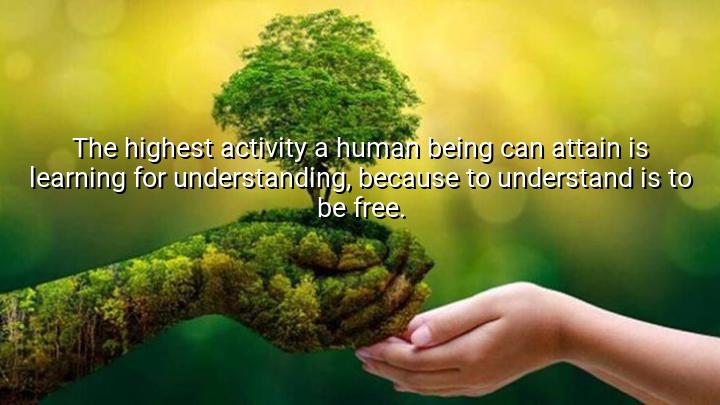




The quote by Baruch Spinoza, "The highest activity a human being can attain is learning for understanding, because to understand is to be free," emphasizes the profound connection between knowledge, understanding, and freedom. Spinoza suggests that the ultimate goal of learning is not merely accumulating information, but achieving deep comprehension that enables one to navigate life with clarity, reason, and autonomy. True understanding empowers individuals to act with wisdom and resist being controlled by ignorance, emotion, or external pressures.
The origin of this quote lies in Spinoza’s work as a 17th-century philosopher, whose writings on ethics, human nature, and rational thought sought to reconcile human behavior with reason and natural law. In his philosophy, knowledge and understanding are not abstract pursuits; they are tools for achieving mental freedom, moral insight, and self-determination. Spinoza viewed learning as a transformative process that elevates the mind and enables a life of intellectual and spiritual liberation.
The quote also highlights that freedom is intrinsically linked to understanding. Spinoza implies that ignorance or misunderstanding restricts one’s ability to make informed choices, leading to a life constrained by fear, prejudice, or manipulation. By contrast, learning for understanding cultivates reason, self-awareness, and independence, allowing individuals to live intentionally and authentically.
Ultimately, Spinoza’s words inspire a mindset of lifelong intellectual pursuit and critical thinking. They encourage individuals to prioritize deep comprehension over superficial knowledge, recognizing that the true measure of human potential lies in the capacity to understand oneself, others, and the world, thereby attaining genuine freedom and self-mastery.

AAdministratorAdministrator
Welcome, honored guests. Please leave a comment, we will respond soon