

Only by going alone in silence, without baggage, can one truly get into the heart of the wilderness. All other travel is mere dust and hotels and baggage and chatter.
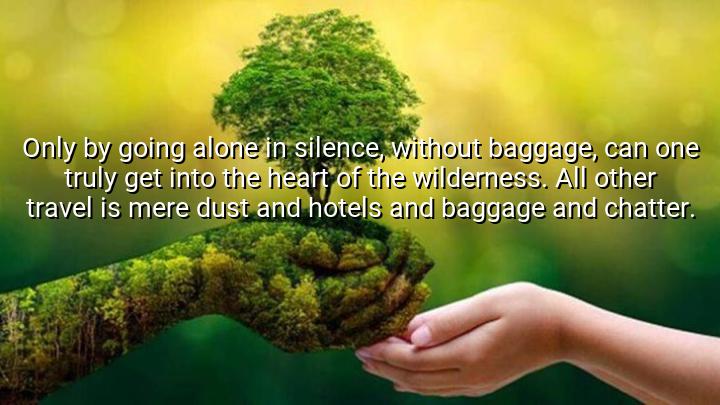




In this quote, John Muir emphasizes the importance of experiencing nature in its purest form by going alone in silence, free from the distractions of modern life. He suggests that in order to truly connect with the heart of the wilderness, one must leave behind the physical and mental baggage that often accompanies typical travel. This includes the noise, clutter, and material concerns that come with conventional journeys. Muir is advocating for a deeper, more introspective experience of nature, one that is unencumbered by external distractions.
Muir’s perspective on travel contrasts the commercialized, superficial nature of modern tourism—symbolized by hotels, baggage, and chatter—with the profound experience of solitude in nature. He implies that true connection with the wilderness can only happen when we are fully present, without the influence of modern conveniences or societal distractions. By removing these external elements, one is able to experience the wilderness in its most authentic and raw form, where the natural world can be appreciated in its full depth and beauty.
The quote also reflects Muir's deep spiritual and philosophical connection to nature. For Muir, the wilderness was not just a physical place, but a sacred space where one could find clarity, peace, and a sense of belonging. His words suggest that a genuine communion with nature requires a personal journey—both inward and outward—that can only be achieved through solitude and silence. This approach aligns with Muir’s broader belief in the restorative and transformative power of nature.
Ultimately, Muir’s quote serves as an invitation to seek a more meaningful experience in nature, free from the distractions and trappings of modern life. It underscores the idea that true exploration of the wilderness requires an unburdened mind and spirit, open to the profound beauty and lessons the natural world has to offer. Through solitude and simplicity, Muir suggests we can truly understand and connect with the essence of the wilderness.

NNguyenhatri
There’s something profound in the idea that true connection to nature requires stripping everything away. It reminds me of how noisy our lives have become—not just physically, but mentally. Muir’s quote makes me want to unplug and walk into a forest with no agenda. But is it really possible to escape all 'baggage'? Don’t we always carry something with us—memories, expectations, fears? Maybe the real journey is learning to be present despite them.
TTThanh Thuy
Muir’s vision is so romantic—it’s almost like a spiritual pilgrimage. But it also makes me think about privilege. Who today has the time, safety, or resources to venture into the wild completely alone and unencumbered? While I admire the purity of his idea, I question whether it’s realistic or accessible for most people. How do we adapt this longing for wild solitude into modern, diverse lifestyles?
TTDao Thuy Tram
I find this quote beautiful, but also a little intense. Is Muir being too absolutist? Can’t someone still feel awe or connection to the wilderness even if they’re staying in a cabin or talking with a friend? Maybe it's not about the absence of baggage or chatter, but about the mindset you bring. Is it really the silence and solitude that matter—or the openness to receive what nature offers?
TLNguyen Thi Thanh Lan
This quote makes me reflect on how cluttered modern travel feels—always about schedules, selfies, and stuff. Muir seems to long for something purer, almost spiritual. But I wonder, can most people today even relate to that kind of solitude? Or are we so conditioned by comfort and connection that we’ve lost the ability to truly be alone with nature? What would it take to reclaim that kind of raw immersion?
NTNguyen Tam
Muir’s words are poetic, but I wonder—does experiencing nature in solitude really offer something fundamentally different from shared exploration? I get the appeal of silence and simplicity, but aren’t human connection and storytelling part of how we understand the wilderness too? Can the soul of the wild still reach you if you're with others, or does companionship dilute the experience the way he suggests?