

No memory is ever alone; it's at the end of a trail of memories, a dozen trails that each have their own associations.
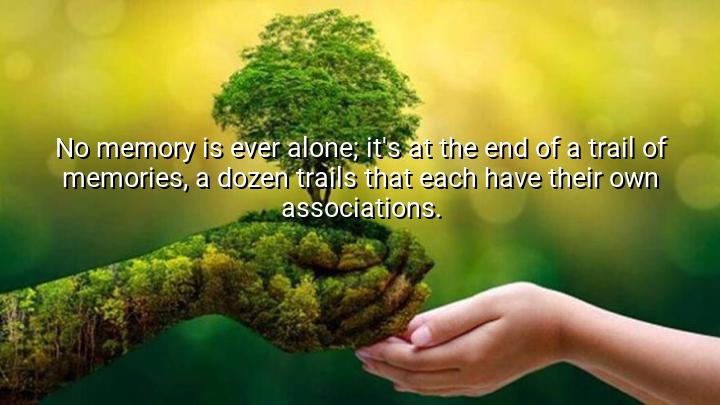




In this quote, Louis L'Amour reflects on the complex nature of memory and how each recollection is interconnected with a series of other memories. He suggests that no memory is ever alone, meaning that every memory is part of a larger network of associations and experiences. Each memory is linked to previous ones, forming a trail that leads to further recollections, creating a web of interconnected moments. This interconnectedness implies that our memories are not isolated events but part of a continuous flow of thoughts and experiences.
L'Amour's idea highlights how memories are shaped by our past experiences, and how one memory often triggers others. This trail of memories represents the rich and complex nature of human cognition, where our recollections are layered with emotions, people, places, and experiences that shape how we remember things. The quote suggests that our past is not a series of individual snapshots, but a network of moments that influence one another and work together to create our full understanding of our personal history.
The phrase "a dozen trails that each have their own associations" further emphasizes the variety and depth of memory. Each trail of memory is unique and carries its own set of connections, which could be tied to different emotions, relationships, or experiences. This suggests that our memories are dynamic, not static, and that we can perceive the same memory in different ways depending on the context and the other memories that are associated with it.
Ultimately, L'Amour’s quote serves as a reminder of how memory is not just a collection of isolated events but a complex and interconnected part of our inner life. It encourages us to understand that every memory is shaped by and connected to others, creating a richer, more nuanced picture of our experiences and history. This perspective helps us appreciate the depth and interconnectedness of our personal pasts and how each memory plays a role in forming our identity.

TMDuyen Vo Thi My
I love how this quote makes memory feel alive—like an ecosystem of experience rather than a file cabinet of isolated facts. It’s interesting to think that recalling one moment might unintentionally trigger joy, sadness, or even something we didn’t know we were still carrying. It makes me curious about how artists and writers tap into this memory network to create such emotionally rich work.
NHBach Nhat Hong
This quote made me reflect on why some memories seem impossible to shake. Maybe it’s not the event itself, but the emotional trail it leaves behind that keeps resurfacing. I wonder—can we ever consciously break a memory trail, or are we forever looping through these mental patterns? It’s fascinating and a little haunting to think about how interconnected our inner world really is.
AQVo Anh Quan
This makes me wonder how much of our identity is shaped by these chains of memory. If no single memory stands alone, then maybe who we are is really just the sum of all these intertwined associations. But what happens when memories get distorted or reinterpreted over time? Can the entire trail shift, and with it, our understanding of ourselves?
DADieu Anh
L’Amour’s quote really captures why it’s so hard to forget certain things. Every memory seems tied to a dozen others, like a spiderweb. Even when you try to move on from the past, something random can bring it all back. Is this why healing from emotional pain can be so difficult—because even unrelated moments might still be tangled up in it somehow?
AAnc
I find this quote oddly comforting. It’s like it gives permission for nostalgia to be messy and nonlinear. Sometimes I’ll remember something small, like a smell or a phrase, and it unlocks a whole flood of related moments. It makes me wonder—do we ever remember anything purely, or are our memories always colored by what came before and after? That makes me question how reliable memory really is.