

Man shall not live by bread alone, but by every word that proceeds from the mouth of God.
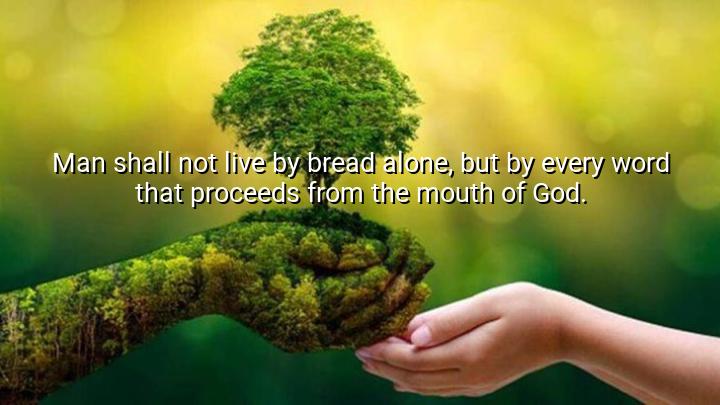




The quote "Man shall not live by bread alone, but by every word that proceeds from the mouth of God" is attributed to Jesus Christ and is found in the Bible, specifically in Matthew 4:4 and Luke 4:4. This statement was made during Jesus' temptation by the devil in the wilderness, where he fasted for forty days. When tempted to turn stones into bread to satisfy his hunger, Jesus responded by emphasizing that spiritual nourishment is just as important as physical sustenance. The quote underscores the idea that life is not sustained by material needs alone but by the spiritual teachings and guidance that come from God.
Jesus' words highlight the importance of faith and spiritual wisdom in guiding human existence. While bread symbolizes physical sustenance necessary for survival, Jesus points out that true life is sustained by a deeper connection to God's word, which provides spiritual fulfillment, purpose, and guidance. This perspective suggests that material wealth or comforts, though necessary, do not provide the lasting fulfillment that comes from following divine wisdom.
The phrase "but by every word that proceeds from the mouth of God" emphasizes that the teachings of God, whether through scripture, prayer, or direct spiritual communication, are essential for a complete life. It suggests that faith and spiritual growth are necessary to navigate life's challenges and that materialism alone cannot provide the inner peace and purpose that one finds through a relationship with the divine.
Ultimately, this quote teaches that balance between physical and spiritual nourishment is essential for a fulfilling life. Jesus encourages his followers to seek sustenance not only in food but in the spiritual wisdom that comes from God. This teaching underscores the idea that while physical needs are important, spiritual growth and connection with the divine are equally vital to achieving a meaningful and purposeful existence.

HLNghiem Hoang Linh
This quote is often quoted in spiritual discussions, but I think it also has a broader philosophical meaning. It speaks to the human condition—how we’re not just physical beings but also intellectual, emotional, and spiritual. But it makes me ask: what happens when people are starved of both kinds of nourishment? Can spiritual strength sustain someone even when physical needs are unmet?
MQDoan Minh Quan
I love the duality this quote presents—body and soul, material and spiritual. It raises a deeper question for me: in our consumer-driven society, have we lost sight of the second half? Are we so focused on 'bread' that we ignore the nourishment that comes from wisdom, compassion, and divine inspiration? It’s a good reminder to reflect on what truly feeds our inner lives.
VTBui van tai
This line strikes me as both profound and challenging. It highlights how spiritual or moral guidance is essential to a full life. But I wonder: how do we recognize what ‘proceeds from the mouth of God’? Is this a call to read scripture, or to tune into a divine presence through other means like conscience or nature? Interpretation seems crucial here, especially across different cultures.
TNpham tuan nguyen
I’ve always found this quote deeply moving. It suggests that faith or divine wisdom offers something essential that goes beyond what the body needs. But I also question how this translates for people of different beliefs—or none at all. Can this idea be interpreted universally, perhaps as a metaphor for purpose or inner truth, regardless of religious tradition?
NCBoi Ngoc Cao
This quote really speaks to the idea that human beings need more than just physical sustenance—we also crave meaning, truth, and spiritual nourishment. But it makes me wonder: in a world where material needs are still unmet for so many, how do we prioritize or even access spiritual fulfillment? Is it a privilege to be able to focus on higher things when survival itself isn’t guaranteed?