

Love is our true destiny. We do not find the meaning of life by ourselves alone - we find it with another.
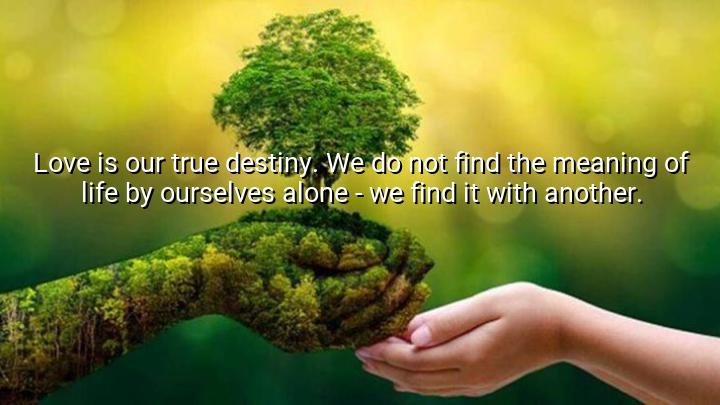




The quote "Love is our true destiny. We do not find the meaning of life by ourselves alone - we find it with another" by Thomas Merton emphasizes the idea that love is central to human existence and purpose. Merton suggests that self-discovery and personal growth are not achieved in isolation but are deeply intertwined with relationships and connection to others. The true meaning of life, according to Merton, is found not by solitude or individualism, but by sharing life with another person, experiencing love, understanding, and mutual growth.
Thomas Merton, an American Trappist monk, writer, and theologian, was known for his works on spirituality, contemplation, and social justice. His reflections on love and community often drew on his experiences of solitude within the monastic life, but he also recognized the transformative power of human connection and the love shared between individuals. Merton’s quote reflects his belief that humans are not meant to live in isolation, but to find their deepest purpose and fulfillment through relationships with others.
The phrase "we find it with another" speaks to the importance of companionship and connection in shaping the course of our lives. Merton suggests that love—whether romantic, familial, or platonic—is the essential vehicle through which we come to understand who we truly are. Through our interactions and shared experiences with others, we discover the meaning of life, emotional depth, and spiritual enlightenment.
Ultimately, Merton’s quote teaches that love is not just a part of life but the foundation of our existence. The quote invites us to reflect on how our connections with others shape our understanding of the world and our place in it. Love, in its many forms, offers a profound sense of purpose, helping us navigate the complexities of life and providing us with the support needed to grow and flourish.

HKHuyen Kim
Does this quote imply that self-discovery is inherently limited without the presence of others? That’s such an interesting concept. I’ve always believed in introspection, but Merton seems to suggest that we can only understand ourselves fully through our relationships. If that’s true, then does love become not just an emotion, but a mirror for the soul? It’s a compelling—and slightly vulnerable—way to look at life.
TLTruc Long
I wonder what Merton would say about people who’ve been hurt by love. For those who have experienced betrayal or loss, this quote might feel more painful than comforting. Is it still our destiny if it brings suffering? Or is he suggesting that even through pain, love is the force that shapes us most deeply? That’s a hard but powerful truth if it’s the case.
TTTrinh Truong
This resonates with me as a rejection of hyper-individualism. But I’m curious: in a society that often glorifies independence and self-sufficiency, how do we reclaim the idea that life’s meaning is relational? Is love the ultimate truth we’ve been conditioned to overlook in favor of personal achievement? Merton seems to say that fulfillment can’t be found in isolation, and I wonder how that reshapes how we define success.
MLDo Minh Luan
I appreciate the spiritual depth of this quote, but I can’t help asking—does it unintentionally place too much pressure on relationships to deliver meaning? What if we enter partnerships expecting them to fulfill our entire sense of purpose? Isn’t there a danger in losing oneself if we look only outward for significance? How do we strike a healthy balance between personal growth and shared connection?
TLLe thi thuy linh
This quote really touches something deep in me. It makes me wonder—are we truly incomplete without another person to share life with? Is Merton talking about romantic love, or could this also refer to friendship, community, or even divine connection? I’d love to explore how broadly we can define 'another' in this context. Maybe love isn't limited to one kind of relationship at all.