

Love seeks one thing only: the good of the one loved. It leaves all the other secondary effects to take care of themselves. Love, therefore, is its own reward.
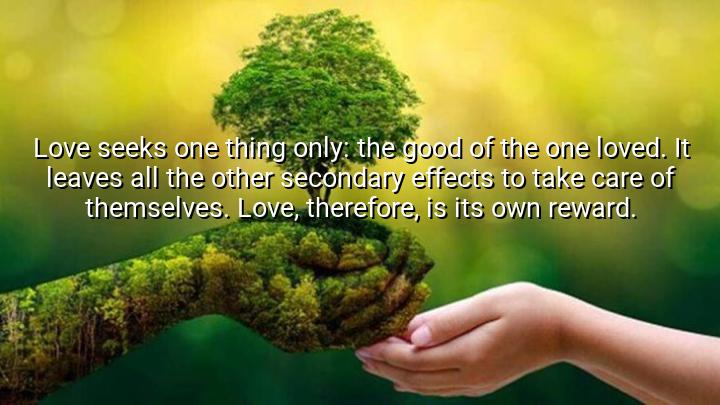




The quote by Thomas Merton, “Love seeks one thing only: the good of the one loved. It leaves all the other secondary effects to take care of themselves. Love, therefore, is its own reward,” emphasizes the selfless and altruistic nature of love. Merton suggests that true love is focused solely on the well-being and happiness of the loved one, rather than on personal gain, recognition, or outcomes. By highlighting that love leaves secondary effects aside, he underscores that authentic love acts without expectation, making the act of loving itself the ultimate fulfillment.
The origin of this quote lies in Merton’s work as a Trappist monk, theologian, and writer, renowned for his reflections on spirituality, contemplation, and the human heart. In his writings, he often explored the transformative power of love, viewing it as a force that transcends self-interest and ego. This quote reflects his belief that love is pure when it prioritizes the good of others, aligning closely with his spiritual philosophy of compassion and service.
Beyond its literal meaning, the quote teaches a profound lesson about intentions in relationships. Merton implies that love is genuine only when it is not transactional or motivated by what one might gain in return. By emphasizing that love is its own reward, he encourages readers to find fulfillment in the act of giving and caring itself, rather than in external validation or reciprocation.
Ultimately, the quote celebrates love as a guiding and ennobling principle. Merton’s words remind us that the highest expression of love is selfless, attentive, and devoted entirely to the good of the beloved. By understanding love in this way, one recognizes that its true power lies not in possessing or controlling, but in freely nurturing and valuing another, creating a profound and enduring spiritual and emotional impact.

AAdministratorAdministrator
Welcome, honored guests. Please leave a comment, we will respond soon