

Knowledge rests not upon truth alone, but upon error also.
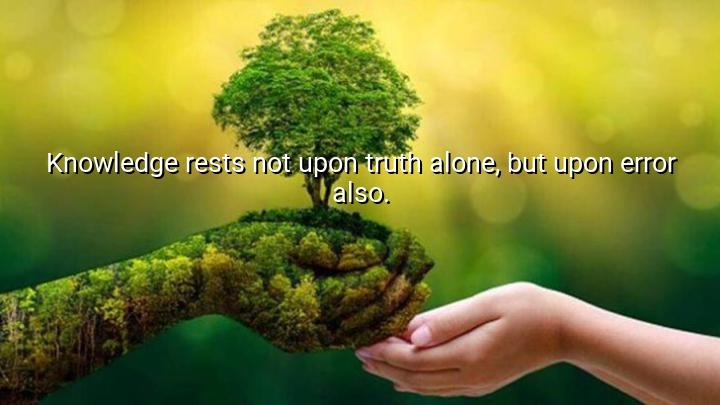




The quote "Knowledge rests not upon truth alone, but upon error also" by Carl Jung suggests that the process of acquiring knowledge is not solely based on truth, but also involves mistakes or errors. Jung emphasizes that learning is a dynamic process where discovery often comes through trial and error, and errors play a vital role in shaping our understanding. Through our mistakes, we are able to refine our knowledge, challenge assumptions, and get closer to the truth. In this sense, error is not something to be feared, but a necessary step in the journey toward deeper insight.
Carl Jung, a Swiss psychiatrist and psychotherapist, was a foundational figure in the development of analytical psychology. His work explored the unconscious mind, archetypes, and the relationship between the conscious and unconscious. This quote reflects his belief in the complexity of human thought and the importance of integrating both the conscious and unconscious parts of the self in the search for knowledge. Jung's view was that human growth and learning come from both the successes and the failures encountered along the way.
The idea that "knowledge rests upon error also" challenges traditional notions of learning as a purely logical or linear process. It suggests that errors, rather than being a hindrance to knowledge, are integral to understanding. When we make mistakes, we are often forced to re-evaluate our assumptions and approach, leading to greater clarity. In this way, error is not a sign of ignorance but a crucial part of the cognitive process, allowing us to refine our perceptions and gain deeper insights.
Ultimately, Jung’s quote highlights the value of mistakes and imperfection in the pursuit of knowledge. It encourages a mindset where growth comes from reflection and learning from both success and failure. By embracing the role of error in the process of understanding, we can foster a more open, flexible, and self-reflective approach to knowledge, allowing for continuous evolution in our thinking and perception.

NTHong Duyen Nguyen Thi
Does this quote imply that error has epistemological value in its own right? I’d love to hear a philosophical perspective on whether errors form a separate category of knowledge—or if they simply highlight the limits of our current understanding. Also, how does this idea interact with modern AI and machine learning, where error feedback loops are used to refine accuracy? Is this the same principle Jung alludes to?
QNQuynhAnh Nguyen
Isn’t this idea incredibly relevant in therapy and self-discovery too? As a reader of Jung, I wonder if he’s also talking about personal growth—how we come to understand ourselves through misjudgments, emotional errors, or even self-deception. Can we ever arrive at self-knowledge without confronting and processing the mistakes we’ve made in life? It feels validating to view errors as part of a deeper psychological process.
MLMy Linh
I appreciate Jung’s perspective here, but it also raises a concern: if knowledge includes error, how do we distinguish between productive mistakes and harmful misinformation? In an age of rampant fake news and conspiracy theories, can this viewpoint be misused to justify falsehoods? What criteria should we apply to ensure that the errors we learn from are legitimate missteps rather than deliberate distortions?
NHNgoc Hoa
This quote makes me reflect on how often we revise what we consider ‘true.’ Scientific progress, for instance, frequently comes from disproving previously accepted theories. Does this mean that error isn't just a stepping stone to truth but a necessary partner to it? If so, how should we rethink the way we teach critical thinking and the value of being wrong in schools and institutions?
KPnguyen thi kim phuong
Is Jung suggesting that making mistakes is just as important as discovering truth? That’s a comforting yet disruptive idea. We often treat errors as failures, especially in formal education or professional environments. But if errors are foundational to gaining knowledge, why do we fear them so much? Shouldn't we be building systems that encourage intelligent risk-taking and analysis of failure rather than penalizing them?