

It's motive alone which gives character to the actions of men.
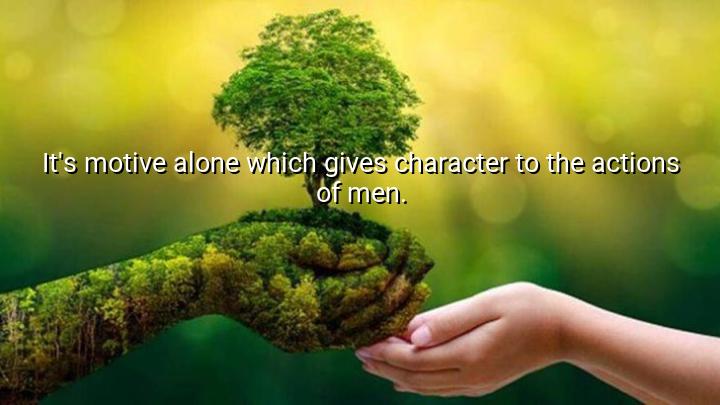




In this quote, Jean de la Bruyère, a French philosopher and moralist, asserts that the motive behind a person's actions is what truly defines their character. He suggests that it is not the outward actions themselves that determine whether someone is good or bad, but the internal reasons or intentions driving those actions. Motive is what provides context and meaning to our behavior, and without understanding the motivation, it is difficult to judge the true nature of a person's actions or their moral character.
La Bruyère's perspective reflects a deeper moral and psychological understanding of human behavior. He argues that people’s actions may appear similar on the surface, but the motive behind those actions reveals their true nature. For example, an action done out of love, selfishness, or envy carries very different moral weight, even if the action itself is the same. This insight invites us to consider the inner motivations behind actions rather than just focusing on external behaviors.
The origin of this quote lies in La Bruyère’s works, particularly his book Les Caractères (The Characters), where he analyzes the behaviors and moral traits of individuals in French society. As a thinker of the 17th century, La Bruyère was concerned with the complex nature of human behavior, focusing on how individuals are defined not just by their actions, but by the moral and psychological forces behind them. His thoughts laid the groundwork for later philosophical discussions about ethics and character.
In essence, La Bruyère’s quote emphasizes the idea that motive is the key to understanding human actions. It reminds us that the true character of a person is revealed by their intentions, and not merely by what they do. The quote encourages a deeper examination of the reasons behind actions, advocating for a more nuanced and thoughtful approach to evaluating human behavior.

HHanh
Reading this, I can’t help but think about how motive influences our empathy toward others. If we knew the true reasons behind every action, would we be more forgiving or more judgmental? Sometimes people act out of fear, love, or desperation—does understanding motive help us connect with their humanity, or does it complicate how we assign praise and blame? It’s a complex interplay that deserves deeper discussion.
LTlong tran
The emphasis on motive as the defining aspect of character is compelling but also troubling. What about cases where good motives lead to bad outcomes? Does the ‘character’ of those actions remain virtuous? I’d love to hear perspectives on how motive interacts with accountability—should someone be praised or blamed based solely on their intention, or must results factor into the judgment of character?
NMHUONG NGO MINH
This quote highlights the power of intention behind actions, which resonates deeply with me. However, it also makes me reflect on self-awareness: are people always conscious of their true motives, or can they be deceiving themselves? How often do our actions reflect subconscious desires rather than clear motives? I’d be interested to explore how understanding our own motives can help us grow and act with more integrity.
TTTuan Tran
I find this thought-provoking because it challenges the way society often judges behavior superficially. If the same action can stem from very different motives, how do we fairly assess someone's character? Could this idea excuse harmful behavior if the motive is deemed ‘good’? It raises the question: Should motives be the ultimate standard for moral judgment, or do consequences matter just as much?
DKTrinh Dang Khoa
This quote makes me wonder about how we judge people's actions. If motive truly defines character, should we focus less on what people do and more on why they do it? But how can we ever fully understand someone’s true motive? Sometimes actions speak louder than words, but can actions alone reveal a person’s character without knowing their intentions? It feels complicated to separate motive from outcome in real life.