

It is better to be alone than in bad company.
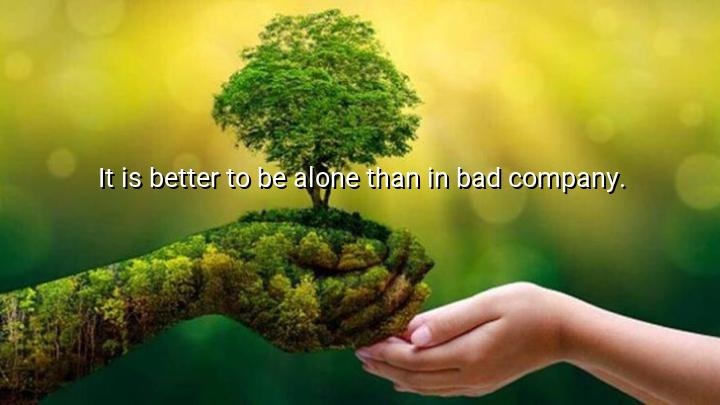




The quote "It is better to be alone than in bad company" by George Washington offers a timeless lesson on the value of discernment in relationships. Washington advises that solitude is preferable to surrounding oneself with people who may have a negative influence, lack integrity, or lead us down the wrong path. The quote underscores the importance of character, both in ourselves and in those we choose to associate with.
George Washington, the first President of the United States and a respected leader of the American Revolution, was known for his commitment to virtue, discipline, and moral leadership. This quote appears in his collection Rules of Civility and Decent Behaviour in Company and Conversation, a set of maxims he copied and lived by from a young age. It reflects his belief that one’s reputation and values can be shaped—or compromised—by the people they keep close.
The phrase "bad company" refers not just to people who are unpleasant, but to those whose actions and attitudes might lead to trouble, regret, or moral compromise. Washington's advice encourages us to choose solitude over companionship that comes at the cost of our principles or peace of mind. It’s a reminder that being alone is not a weakness, but sometimes a sign of strength and self-respect.
Ultimately, this quote promotes the idea of quality over quantity when it comes to relationships. It encourages people to wait for meaningful, positive connections rather than settle for company that could do more harm than good. In choosing solitude over toxic relationships, we preserve our dignity, our clarity, and our true selves.

93Minh Thu 9a 35.Pham
This quote sounds so logical—and yet, it's incredibly difficult in practice. There's comfort in familiarity, even when the company is bad. I wonder, what makes it so hard for people to choose solitude over toxic dynamics? Is it fear of loneliness, or the way we’re socially conditioned to define worth through relationships? It makes me think about how solitude can be reframed as a courageous and healing act, not a lonely one.
HK10A8_20_ Hoang Khanh
I love how timeless this quote is. It applies as much to friendships as it does to romantic relationships. But I also think it raises an important question: are we taught to value quality over quantity in relationships early enough? Maybe if we encouraged more self-worth and emotional independence, people would be less likely to stay in bad company to begin with. How do we teach that kind of emotional discernment?
HDHuan Dinh
This quote makes me reflect on how many people settle for unhealthy relationships just to avoid being alone. But is that really a better alternative? Emotional safety seems like a non-negotiable, yet it’s often compromised for the sake of company. I’m curious—what are the signs we overlook in bad company? And how do we build the courage to walk away from people who may not be outright harmful but aren’t good for us either?
HHinhin
I find this quote empowering, especially for anyone who's struggled with toxic relationships. It reminds me that solitude isn’t a failure—it can actually be a form of self-respect. But I also question: does choosing solitude get easier with age or experience? When you're younger, being alone can feel like rejection, not strength. I wonder how we can help people reframe solitude as protective rather than punishing.
KYKim Yen
This quote really resonates with me. It’s such a simple truth, but one that’s often hard to follow. We sometimes keep people around out of habit, fear of loneliness, or social pressure—even when those relationships bring more harm than joy. But I wonder, how do you truly know when company has turned 'bad'? What if it’s subtle—like emotional draining or passive disrespect? That gray area is what I find hardest to navigate.