

Is he alone who has courage on his right hand and faith on his left hand?
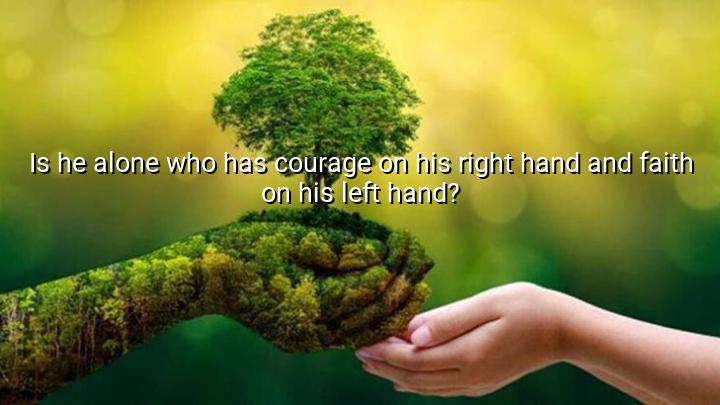




The quote "Is he alone who has courage on his right hand and faith on his left hand?" by Charles Lindbergh explores the idea that true companionship in difficult times can come from within. Lindbergh suggests that a person equipped with courage and faith is never truly alone, even in the absence of others. These inner qualities provide the emotional and spiritual strength needed to face life’s challenges, offering a sense of support and presence that transcends physical solitude.
Charles Lindbergh, the famed aviator, made history in 1927 by completing the first solo nonstop flight across the Atlantic Ocean. This quote likely reflects his experience of being physically isolated during that flight, yet feeling sustained by his belief in himself and his mission. The vast emptiness of the sky did not diminish him, because he was anchored by an inner faith and bravery that kept him focused and determined.
The symbolic use of “right hand” and “left hand” to represent courage and faith evokes the image of these virtues being always at one’s side, ready to guide and uphold. It paints a picture of self-reliance supported by deeply held principles. Rather than seeking external reassurance, Lindbergh teaches that inner conviction can be the most reliable companion in moments of solitude or adversity.
Ultimately, Lindbergh’s quote is a powerful affirmation of inner strength. It reminds us that with the right mindset and values, we can endure even the most lonely or daunting circumstances. Courage and faith, when held close, become companions that guide us forward, making solitude not an emptiness, but a space of quiet fortitude.

DKduy khanh
This quote makes me reflect on the difference between solitude and spiritual companionship. Maybe Lindbergh is saying that when you have unshakable belief in something greater and the bravery to act on it, you’re never truly isolated. But still, I ask—does that mean emotional support from others becomes unnecessary? Or is this more about finding a deeper sense of self that prepares us to connect from a place of wholeness?
GHBui Gia Huy
It’s a beautiful sentiment, but I wonder if it’s also a bit romanticized. Inner strength is powerful, no doubt—but is it fair to suggest that it replaces the need for human presence? Courage and faith might guide us, but can they comfort us in the way that a voice or touch can? I’m fascinated by the balance this quote is trying to strike between independence and emotional truth.
QKNgo Quang Khai
This quote is both comforting and provocative. It suggests that solitude doesn’t have to equal emptiness if we carry strength and belief within us. But it makes me question: are courage and faith substitutes for human connection, or are they the tools that help us endure the absence of it? Can they truly make someone feel 'not alone,' or do they just help us survive until community returns?
TMTrung Tin Mai
There’s something noble and almost heroic in this question, but I’m curious—does this reflect a worldview that elevates stoicism over vulnerability? I wonder if it's more common for people to mask their loneliness with strength and belief, rather than address their emotional needs directly. Is it okay to admit that even the bravest, most faithful among us still crave the simple comfort of companionship?
THnguyen thuy ha
I really admire the idea behind this quote—it paints a picture of someone grounded in conviction and resilience. But can one still feel alone even with courage and faith? Those inner qualities provide direction, sure, but do they offer the warmth of human connection? Maybe this is more about redefining what it means to be alone—are we ever truly isolated if we feel anchored in belief and purpose?