

Real freedom lies in wildness, not in civilization.
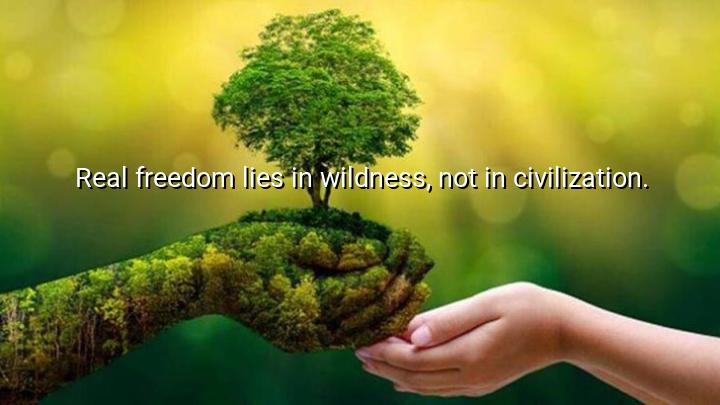




In this quote, Charles Lindbergh expresses his belief that true freedom is found in the untamed, natural world, or wildness, rather than within the confines of civilization. Lindbergh suggests that while civilization can bring order and structure, it also imposes limitations on individual autonomy and the human spirit. For Lindbergh, the essence of freedom lies in the ability to live unrestrained, outside the artificial boundaries created by society.
The contrast between wildness and civilization reflects Lindbergh’s personal values and experiences, especially as someone who was deeply connected to nature and exploration. As an aviator, Lindbergh had a unique appreciation for the expansive, open skies, and this quote can be seen as an extension of his fascination with freedom found in the natural world. Wildness, in this context, symbolizes a life that is not bound by rules, structures, or societal expectations.
Lindbergh's view of freedom challenges conventional ideas about the progress and benefits of civilization. While civilization provides comfort, security, and social structures, Lindbergh argues that it comes at the cost of a certain level of personal freedom. The quote suggests that the true, untainted freedom is found in the simplicity and authenticity of nature, where people can be closer to their primal selves, away from the artificial constructs of modern life.
Ultimately, Charles Lindbergh's quote highlights his belief in the liberating power of wildness and nature, viewing it as a space where freedom can be fully realized. It challenges the notion that the comforts of civilization are the ultimate form of freedom, urging instead for a return to a more primitive, unencumbered existence where the individual is free from the constraints of societal norms.

AAdministratorAdministrator
Welcome, honored guests. Please leave a comment, we will respond soon