

Invisible things are the only realities; invisible things alone are the things that shall remain.
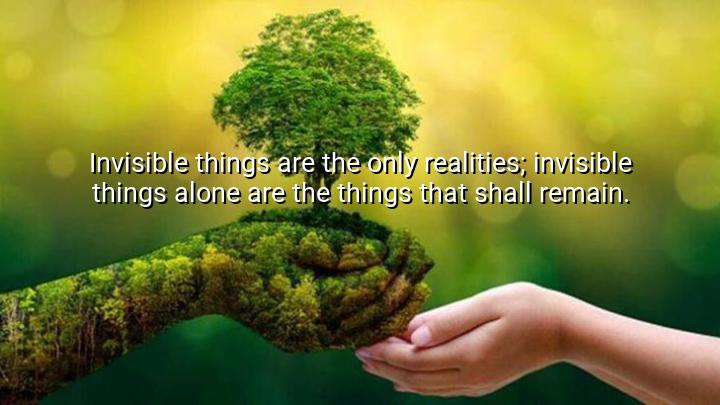




The quote "Invisible things are the only realities; invisible things alone are the things that shall remain" is from William Godwin, an English philosopher, journalist, and novelist, best known for his work An Enquiry Concerning Political Justice. In this statement, Godwin explores the idea that the most important aspects of life are those that cannot be seen or measured, such as thoughts, ideas, and principles. He suggests that while material possessions and physical objects may seem real and significant, it is the invisible elements—like truth, knowledge, and human values—that ultimately endure.
Godwin’s words challenge the conventional view that the tangible and material world holds the most importance. He posits that these visible things are fleeting and temporary, whereas the intangible—the spiritual, intellectual, and emotional aspects of existence—hold lasting significance. This perspective is in line with Godwin's broader philosophical views, which emphasized the power of reason and human nature over physical realities and material wealth.
The idea that invisible things are the only realities suggests that true understanding and lasting impact are derived from internal experiences and moral qualities. For Godwin, ideas and conscience are the forces that shape human life and society, far more than external, visible factors. The assertion that these invisible things "shall remain" implies that the core of human existence is grounded in these abstract principles, which continue to influence future generations.
In essence, Godwin’s quote serves as a reminder of the transitory nature of physical existence and the permanence of intangible elements like thought, belief, and virtue. He calls for a focus on the invisible forces that shape our actions, relationships, and society, emphasizing that these are the aspects of life that ultimately define us and endure through time.

NHNguyen Phan Ngoc Hung
I’m torn. On one hand, I love the idea that the unseen aspects of life are the most enduring. But I also question whether that's entirely true. Isn’t it the interaction between the visible and invisible that gives life meaning? A hug, for instance, is both physical and emotional. Can we really separate the two? Or is Godwin just trying to remind us not to take the unseen for granted?
TKtran khai
This quote sounds poetic, but also kind of unsettling. If only the invisible things remain, what does that say about our obsession with legacy, fame, or wealth? Are we investing in the wrong kinds of permanence? I wonder how this belief plays out in everyday decisions—should we focus more on relationships, intentions, or inner peace? It's a beautiful thought, but difficult to live by in such a materialistic world.
NPNgocyaua Pham
This feels like a deeply philosophical statement. It reminds me of how ideas, beliefs, and values shape history far more than physical monuments ever could. But then, how do we preserve the invisible? Can things like love or justice truly last without being embedded in systems or stories? I worry that without tangible support, these invisible ‘realities’ can fade. Maybe that’s why storytelling and tradition are so crucial.
HGhien giang
I find this quote almost mystical. It evokes a sense of the spiritual, even if you’re not religious. What does it really mean for something to be ‘real’ if you can’t see or touch it? Emotions, consciousness, legacy—all invisible, yet incredibly powerful. It makes me wonder: are we living in denial of these invisible forces, or have we just forgotten how to recognize them in our daily lives?
ATNguyen thi anh thu
This quote really stopped me in my tracks. It makes me question what we prioritize in life—so much of our energy goes into chasing material things, yet Godwin suggests it's the unseen—like love, memory, or thought—that truly endures. Do you think society has become too focused on what’s tangible and measurable? And if so, how do we begin to value the intangible again, especially in a world so obsessed with proof and visibility?