

The extent of our progress in the cultivation of knowledge is unlimited.
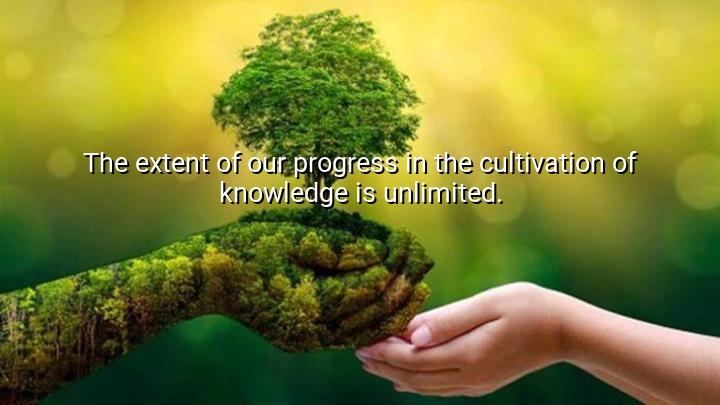




The quote by William Godwin reflects his belief in the boundless potential of human advancement through the cultivation of knowledge. By declaring that the extent of progress is unlimited, he suggests that there are no fixed limits to what humanity can achieve intellectually, morally, or socially. Knowledge, for Godwin, is not a closed system but an ever-expanding force that continues to push the boundaries of human possibility.
This statement underscores the Enlightenment ideal that through reason and education, humanity can overcome ignorance, superstition, and oppression. Godwin emphasizes that the pursuit of progress is continuous—each generation can build upon the discoveries and wisdom of the past, leading to greater improvements in society and human well-being.
The quote also reflects Godwin’s optimism about human perfectibility. He believed that as knowledge advances, people become more capable of making just, rational, and ethical decisions. This aligns with his larger philosophical vision, where intellectual growth leads to social reform, reduced inequality, and greater freedom. In this way, knowledge is not just individual enrichment but a collective path toward a better world.
The origin of this quote comes from Godwin’s work as a political philosopher in the late 18th and early 19th centuries, particularly his influential book An Enquiry Concerning Political Justice (1793). As one of the first modern proponents of anarchism and a key figure of Enlightenment radicalism, Godwin believed in the transformative power of ideas. His words capture the spirit of an era that saw knowledge as the primary driver of human progress and societal improvement.

AAdministratorAdministrator
Welcome, honored guests. Please leave a comment, we will respond soon