

India is the meeting place of the religions and among these Hinduism alone is by itself a vast and complex thing, not so much a religion as a great diversified and yet subtly unified mass of spiritual thought, realization and aspiration.
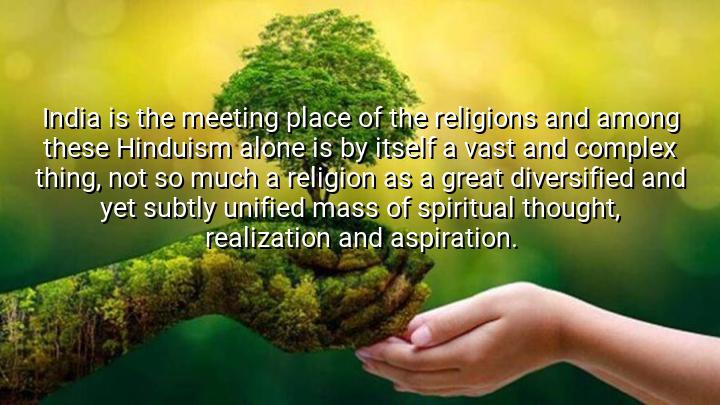




The quote "India is the meeting place of the religions and among these Hinduism alone is by itself a vast and complex thing, not so much a religion as a great diversified and yet subtly unified mass of spiritual thought, realization, and aspiration." by Sri Aurobindo reflects the unique and multifaceted nature of Hinduism within the broader context of Indian spirituality. Aurobindo suggests that India serves as a crossroads for various religions, including Buddhism, Islam, Christianity, and others, but Hinduism stands out as a particularly expansive and intricate system of thought and practice. He argues that Hinduism is not just a traditional religion with a single doctrine but a vast, diversified collection of spiritual ideas and practices that have evolved over centuries.
Aurobindo’s emphasis on Hinduism being a "great diversified and yet subtly unified mass" speaks to the pluralistic and inclusive nature of the faith. Unlike religions that may have a singular doctrine or rigid structure, Hinduism encompasses a variety of philosophies, deities, and practices that can seem contradictory at first glance. However, Aurobindo argues that despite these differences, they are all bound by a subtle unity that reflects a deeper, unified spiritual purpose. This diversity allows for personal exploration of spirituality, enabling each individual to find their own path toward realization and liberation.
Furthermore, Aurobindo emphasizes that Hinduism is not merely a set of rituals or beliefs, but an aspiration toward a higher spiritual goal—self-realization and union with the divine. The term realization refers to the deep inner understanding and awakening that one experiences on the spiritual journey. This journey involves both individual and collective efforts to attain a state of divine awareness and enlightenment.
The origin of this quote comes from Sri Aurobindo, an Indian philosopher, poet, and spiritual leader who played a key role in the Indian independence movement and the development of modern spirituality. Aurobindo’s writings focus on the integration of spiritual evolution with the practical realities of life. He viewed Hinduism not just as a religious tradition but as a dynamic and evolving system of thought that addresses the deep questions of existence, offering a path toward spiritual growth and transformation.

TVNguyen Thi Thao Van
I’m intrigued by how Hinduism is described as an ongoing ‘realization and aspiration.’ Does this imply that the religion is evolving and open-ended rather than fixed? How does this dynamic quality impact followers’ spiritual journeys? Can this openness be a strength in adapting to modern challenges and global interactions?
HNHai Nam
The notion of a ‘subtly unified mass’ suggests a delicate balance within Hinduism’s diversity. What mechanisms—rituals, philosophy, cultural traditions—help maintain this unity? Could this model offer insights for other pluralistic societies struggling with religious diversity? I’d love to explore how unity and diversity coexist in spiritual contexts.
UGUser Google
This description raises interesting questions about the nature of religious identity. If Hinduism is more a ‘mass of spiritual thought’ than a strict religion, how do followers define themselves within it? Does this fluidity allow for more personal interpretation, or does it challenge the idea of a unified community? How might this influence interfaith dialogue?
QLQuan Le
I find the idea of India as a meeting place of religions fascinating. How does this coexistence shape the social and cultural fabric of the country? Are there tensions or harmonious exchanges between different faiths? Also, what makes Hinduism uniquely expansive compared to other religions present in India?
PPimm
This quote beautifully captures the diversity within Hinduism, portraying it as more than just a religion but a vast spiritual tradition. I’m curious how this complexity affects the way individuals experience and practice their faith in India. Does this diversity lead to greater spiritual richness, or can it create confusion and fragmentation? How does Hinduism’s subtle unity hold together such a broad spectrum of beliefs and practices?