

She saw too that man has the power of exceeding himself, of becoming himself more entirely and profoundly than he is, truths which have only recently begun to be seen in Europe and seem even now too great for its common intelligence.
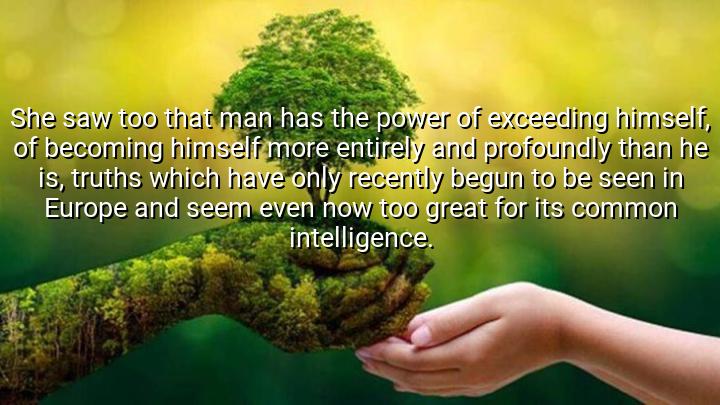




The quote by Sri Aurobindo speaks to the potential of human beings to transcend their limitations and evolve into more profound versions of themselves. When he says that "man has the power of exceeding himself," he emphasizes humanity's capacity for growth, both spiritually and intellectually. It suggests that human beings can move beyond their current state, achieving a deeper and more complete sense of self and purpose.
Aurobindo also points out that these truths—that we can become ourselves more entirely—are only beginning to be understood in Europe, indicating that the realization of human potential is a relatively recent development in Western thought. He contrasts this with the idea that these truths may seem too profound or complex for the common intelligence of the time, suggesting a disconnect between profound spiritual ideas and the more materialistic mindset prevalent in many societies.
The origin of this quote lies in Sri Aurobindo’s spiritual and philosophical teachings, particularly his vision of human evolution. Aurobindo believed in the idea of a divine evolution, where individuals could transcend their physical and mental boundaries to reach a higher state of being. This philosophy was grounded in his deep understanding of yoga and meditation, which he believed could unlock human potential on a cosmic level.
In this sense, the quote reflects Sri Aurobindo's belief in the transformative power of self-realization. It implies that humanity’s evolution is not just physical but spiritual, and that this deeper understanding of truths is essential for people to break free from societal constraints and realize their fullest potential. This idea challenges traditional ways of thinking, inviting individuals to explore higher planes of existence and understanding.

AAdministratorAdministrator
Welcome, honored guests. Please leave a comment, we will respond soon