

In the absence of any other proof, the thumb alone would convince me of God's existence.
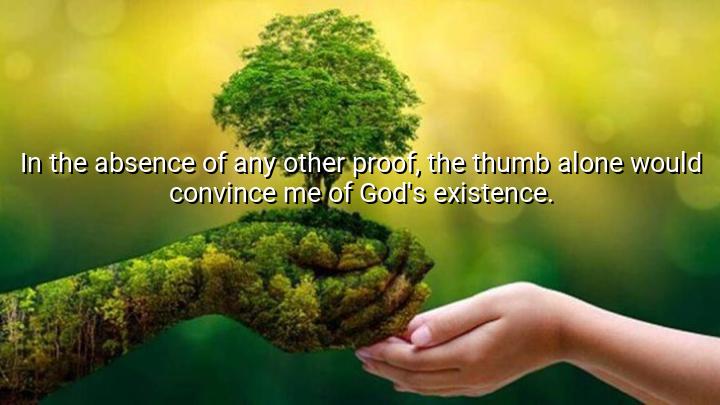




The quote "In the absence of any other proof, the thumb alone would convince me of God's existence" by Isaac Newton reflects his belief in the divine nature of the universe and the intelligent design behind creation. Newton suggests that the complexity and precision of even the simplest part of the human body, such as the thumb, serve as a testament to the existence of a higher creator. He implies that the design of the thumb, with its ability to perform such intricate functions, is so remarkable that it alone could be seen as proof of God's existence and wisdom in creating the world.
Isaac Newton, one of the most influential scientists and mathematicians in history, is best known for his laws of motion and universal gravitation. Despite his groundbreaking work in physics and mathematics, Newton was also deeply religious and believed in the harmony between science and faith. This quote illustrates his view that the natural world, and even the smallest details of human anatomy, could provide evidence of a higher power behind creation, reflecting his belief in God’s design.
The phrase "the thumb alone would convince me of God's existence" underscores the idea that divine intelligence is evident in the physical world. Newton admired the complexity of nature and believed that such complexity could not have arisen by chance but must have been the result of a purposeful creator. The thumb, in particular, represents the unique and functional nature of human design, which Newton saw as evidence of a higher being's involvement in the creation of life.
Ultimately, Newton’s quote reflects the intersection of science and faith, where he saw the natural world, including human anatomy, as a reflection of divine order. This perspective suggests that the more one understands the complexities of the universe, the more one is drawn to the idea of a creator. Newton’s words encourage an appreciation for the beauty and purpose inherent in the world around us, which he viewed as clear evidence of God's presence and intelligent design.

TTDao Thu Thuy
This quote makes me think about the role of intuition in faith. Is Newton suggesting that sometimes spiritual truth isn’t found in elaborate doctrine or scientific proof, but in a personal encounter with beauty and function? It reminds me that belief can be both intellectual and deeply felt. Does that make it more valid—or just more personal? Maybe both approaches are equally meaningful in the search for truth.
GHNguyen Gia Huy
I’m intrigued by Newton’s appeal to physical design as evidence of the divine. But doesn’t that open the door to subjectivity? What might convince one person of God's existence might mean nothing to someone else. If the thumb is enough for Newton, what about those who see randomness or evolutionary logic instead? Can personal awe truly be a universal argument for faith?
ATAnh Truong
There’s something really touching about this quote—almost childlike wonder. In today’s hyper-analytical world, is it still possible to be moved spiritually by the elegance of biology? Or have we become too used to reducing everything to data and function? I think Newton is reminding us that the more we understand creation, the more mysterious and miraculous it can seem, not less.
ATAn Tran
I love the poetic weight of this quote, but it also raises a question: what is it about the thumb specifically that makes it such compelling evidence for Newton? Is it its uniqueness, versatility, or its role in human development? The thumb is undeniably impressive from an evolutionary standpoint too. Could Newton’s wonder at the thumb bridge the gap between science and spirituality rather than divide them?
YNHai Yen Nguyen
This quote is powerful in its simplicity, but I can’t help wondering—does it imply that natural design is inherently proof of a designer? It seems to echo intelligent design arguments, which are still hotly debated. From a scientific perspective, can functionality and complexity alone justify belief in a creator? Or is this more about Newton’s personal awe and emotional conviction rather than empirical reasoning?