

I'm very happy alone.
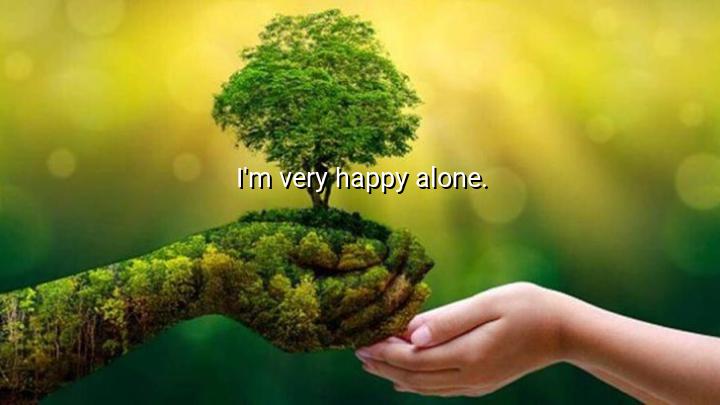




The quote "I'm very happy alone" by Octavia E. Butler speaks to the power of solitude and self-sufficiency. Rather than viewing being alone as a negative state, Butler expresses contentment and fulfillment in her own company. This perspective challenges the common societal belief that happiness must be tied to relationships or social approval. In her words, happiness is something that can be cultivated from within, without needing constant interaction or external validation.
Octavia E. Butler was a renowned African American science fiction author, known for exploring themes such as identity, isolation, and personal autonomy. Her experiences as a Black woman in a predominantly white, male-dominated literary genre likely influenced her embrace of independence. The quote reflects her inner strength and the value she placed on creative space, which was often nurtured through time spent alone.
For Butler, solitude may have also been essential to her creative process. Writing requires deep focus, reflection, and often a disconnect from external noise. Her declaration of being “very happy alone” can be seen as an affirmation of her artistic lifestyle, where solitude was not just a preference but a necessary condition for productivity and clarity.
Ultimately, this quote underscores the importance of understanding and honoring one’s personal needs. For some, like Butler, being alone is not about loneliness but about freedom, peace, and the ability to live authentically. It invites us to reconsider our own relationship with solitude and embrace it as a potential source of growth and joy.

KLKhanh Linh
Butler’s quote makes me think about how often we tie self-worth to being in relationships. To say 'I'm very happy alone' is almost a revolutionary act in a culture obsessed with connection. But does that mean she didn’t value relationships at all, or just that she didn’t rely on them for happiness? There’s a big difference between being alone and being lonely, and I think she understood that beautifully.
HTNguyen Ha Trang
I love the quiet assurance in this quote. It’s a reminder that solitude doesn’t have to be a void—it can be a source of strength, creativity, and joy. But I wonder, do people who are happy alone sometimes get misunderstood? Is there a social stigma attached to choosing solitude that makes people question your happiness, even when you’re fully content?
TNLe The Nguyen
This quote is deceptively simple but profound. It made me ask myself: am I comfortable enough with myself to truly be happy alone? Or do I rely too much on distraction or validation from others? There’s something inspiring about the calm confidence in her words, and it challenges the assumption that solitude equals sadness or lack.
TVHa Thi Van
Octavia E. Butler’s statement resonates with me, but it also makes me curious—what does being happy alone really look like? Is it about freedom, peace, creative space, or simply not feeling the need to explain yourself to others? I wonder if her sense of contentment came from self-sufficiency or from a deeper kind of spiritual alignment. Can more people reach that place, or is it a rare personality trait?
NBHong Nhung Bui
This quote feels incredibly empowering. In a world that often equates happiness with relationships or social approval, it's refreshing to hear someone confidently claim joy in solitude. But I do wonder—was that happiness hard-won for Butler? Did she have to unlearn societal expectations about companionship to fully embrace being alone? It makes me think about how many people fear solitude without ever exploring its richness.