

Religion is everywhere. There are no human societies without it, whether they acknowledge it as a religion or not.
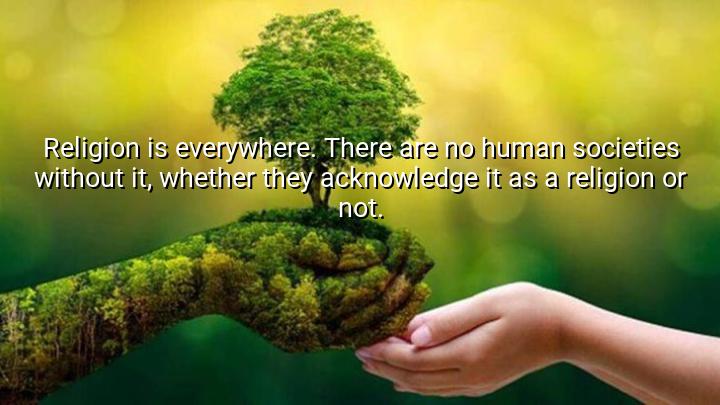




The quote "Religion is everywhere. There are no human societies without it, whether they acknowledge it as a religion or not" by Octavia E. Butler suggests that religion is a fundamental part of the human experience, present in all societies, regardless of whether it is formally recognized or named as such. Butler, a celebrated science fiction writer, often explored themes of identity, power, and belief in her works, and this quote reflects her view that human beings inherently create systems of meaning, moral codes, or spiritual practices, which serve as a foundation for how they navigate the world.
Butler's statement also highlights the ubiquity of religion in its broadest sense, beyond organized institutions or rituals. Even in societies or communities that may not identify with a particular religious tradition, there are still shared values, customs, and belief systems that function similarly to what we consider religion. Whether through collective myths, cultural practices, or ethical norms, people create frameworks for understanding existence, life’s purpose, and the forces that shape their world. These frameworks, regardless of their form, serve as a type of religious structure in guiding people's actions and worldviews.
The quote challenges the modern tendency to think of religion as something separate from daily life or only tied to specific institutions. Butler’s perspective suggests that spirituality and belief are intrinsic to humanity, manifesting in various ways, from rituals and symbols to the broader ideals that govern social conduct. Whether these systems are recognized as formal religions or not, they perform a similar function in helping people find meaning and order in their lives.
As a writer, Butler often used speculative fiction to explore complex issues like humanity, social structures, and the evolution of cultural norms. This quote reflects her broader exploration of how belief systems evolve and the impact they have on individuals and societies. In many of her novels, such as Parable of the Sower, she delves into how belief and faith can shape society in profound ways, both for better and for worse. Her view on religion reflects an understanding of its deep connection to the human condition, transcending cultural boundaries and enduring through time.

AAdministratorAdministrator
Welcome, honored guests. Please leave a comment, we will respond soon