

If we were to wipe out insects alone on this planet, the rest of life and humanity with it would mostly disappear from the land. Within a few months.
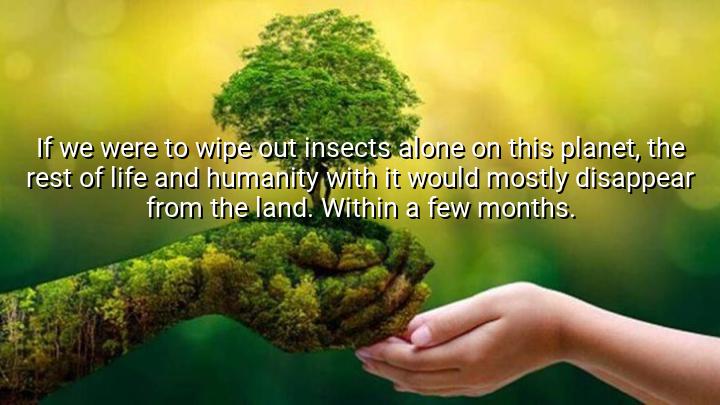




The quote "If we were to wipe out insects alone on this planet, the rest of life and humanity with it would mostly disappear from the land. Within a few months." by E. O. Wilson emphasizes the crucial role insects play in maintaining the balance of life on Earth. Wilson, a renowned biologist and entomologist, highlights that insects are foundational to many ecosystems, providing vital services such as pollination, decomposition, and serving as food for many other species. Without insects, the entire food chain would collapse, leading to widespread extinction.
Wilson’s statement underscores the interdependence of all life on Earth. While insects may seem small or insignificant to many, they are deeply embedded in the structure of ecosystems, helping plants reproduce and breaking down organic matter to recycle nutrients. If insects were to disappear, plant life would suffer, leading to the collapse of herbivores and carnivores that rely on plants or other animals for food. This domino effect would eventually devastate human life as well, since agriculture, pollination, and biodiversity are all intimately connected with the health of insect populations.
The quote also draws attention to the fragility of natural systems and how human actions can have far-reaching consequences. It serves as a stark reminder that even small creatures, like insects, are indispensable for the survival of all life forms on the planet. By threatening insect populations, we also jeopardize the stability of the environment and ecosystems that support human existence.
Ultimately, Wilson’s words underscore the importance of conserving and protecting even the most overlooked species. Insects may not always be visible or appreciated, but their ecological significance is immense. This quote calls for a greater understanding of the complexity of nature and the need to safeguard all forms of life to ensure the sustainability of our planet.

TNLe Thu Ngan
This quote made me feel a sense of guilt, honestly. I’ve never really liked insects, but now I realize how dependent I am on creatures I’ve spent most of my life trying to avoid. How do we change a culture that instinctively swats, sprays, and squashes bugs into one that respects and protects them? Maybe the first step is shifting the narrative—from disgust to gratitude.
PUTran Phuong Uyen
It’s both fascinating and terrifying how overlooked insects are in the conversation about biodiversity. Wilson’s quote paints a picture of just how fragile our ecosystem really is. I can’t help but wonder—do we even have the scientific infrastructure in place to fully track insect populations and their role in various ecosystems? If not, are we blindly edging toward ecological collapse without fully grasping it?
ANThu Anh Nguyen
This is one of those statements that makes you stop and reevaluate everything. We spend so much effort trying to eliminate bugs from our homes and crops, but rarely consider what their absence would mean for soil, pollination, decomposition, or food chains. It’s sobering to realize how interdependent we truly are with even the smallest forms of life. Shouldn't we be treating insect conservation as a global priority?
VCDoan Van Chi
Wilson’s quote really puts things into perspective. It makes me ask: how close are we to such a scenario already, given current pesticide use, habitat destruction, and climate change? Are we unknowingly setting off a chain reaction that could threaten our own survival? This isn’t just about environmentalism—it’s about self-preservation. Why aren’t governments acting more urgently to protect these incredibly fragile ecosystems?
TNhuyen tho truong nguyen
This quote is absolutely chilling—and deeply eye-opening. We often treat insects as nuisances, yet Wilson reminds us how foundational they are to life on Earth. It makes me wonder why their role isn’t more prominently taught in schools or discussed in mainstream environmental conversations. How do we shift public perception so that insects are seen not as pests, but as essential workers in the grand web of life?