

A very Faustian choice is upon us: whether to accept our corrosive and risky behavior as the unavoidable price of population and economic growth, or to take stock of ourselves and search for a new environmental ethic.
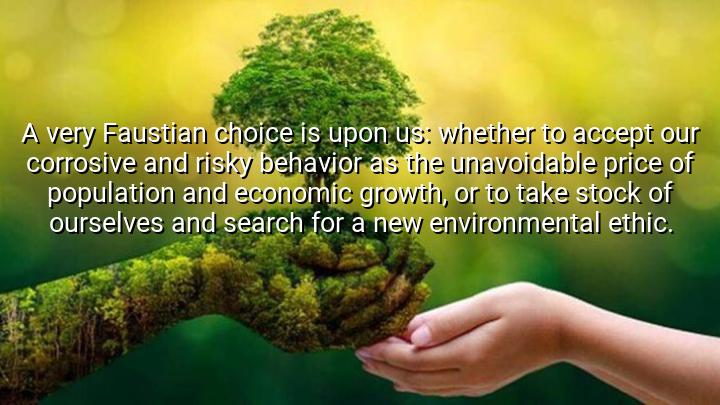




E. O. Wilson's quote draws on the Faustian choice, a reference to the legend of Faust, who made a pact with the devil in exchange for worldly gains. Here, Wilson suggests humanity faces a similar dilemma: whether to accept our corrosive and risky behavior—the environmental damage caused by rapid population growth and economic growth—or to confront this reality and strive for a new environmental ethic. This choice represents a moral crossroads between continuing on a destructive path or seeking a more sustainable, responsible approach to development.
Wilson’s reference to a Faustian choice highlights the tension between short-term gains and long-term consequences. He is questioning whether we will prioritize economic and population growth at the expense of the environment or whether we will take stock of ourselves and acknowledge the need for a new mindset. This involves a shift toward an ethic that balances human development with the health of the planet, promoting sustainability and ecological responsibility.
As a renowned biologist and environmental advocate, Wilson’s work often revolved around the idea of humans being stewards of the Earth, rather than exploiters. His call for a new environmental ethic challenges us to rethink our relationship with nature. It’s an appeal for ethical reflection on how human actions affect the planet and a plea for a moral approach to ecological challenges that transcends short-term economic interests.
Wilson’s quote is a powerful reminder that the current path of unchecked growth and environmental degradation is unsustainable. He urges us to make a conscious decision to pursue a future where economic prosperity does not come at the cost of the biosphere, but instead fosters a balance between progress and preservation.

AAdministratorAdministrator
Welcome, honored guests. Please leave a comment, we will respond soon