

I was never less alone than when by myself.
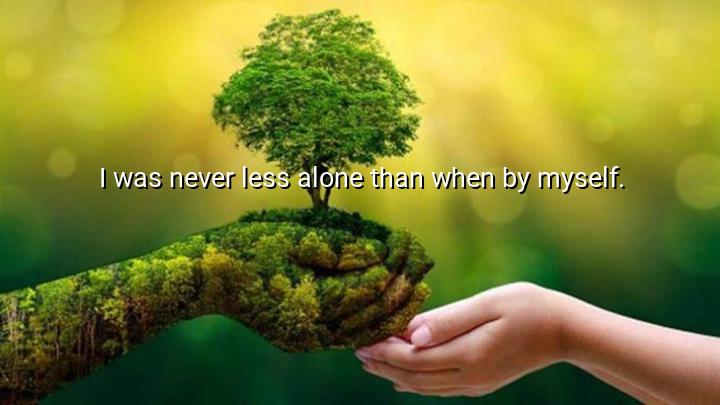




The quote "I was never less alone than when by myself" by Edward Gibbon reveals the deep satisfaction and richness that can be found in solitude. Rather than equating being alone with loneliness, Gibbon expresses a paradox: that he felt most connected, at peace, or even most alive when in his own company. This suggests a strong inner life and a comfort with introspection and self-reflection.
Edward Gibbon, an 18th-century historian best known for his monumental work The History of the Decline and Fall of the Roman Empire, was a man of great intellectual discipline. His work required long hours of solitary reading, writing, and thought. This quote likely reflects his appreciation for quiet time, where ideas, creativity, and understanding could flourish without distraction.
The statement also aligns with Enlightenment values, where the power of the individual mind and reason were held in high regard. For Gibbon, being by himself wasn’t isolating—it was liberating, offering space to think freely, without external pressures. In this sense, his solitude was not empty but enriching, filled with learning, contemplation, and purpose.
Ultimately, the quote encourages us to reframe how we view being alone. It suggests that solitude can be a source of strength, not something to fear or avoid. For those who embrace it, time spent alone can deepen self-awareness, spark creativity, and provide a profound sense of inner companionship.

NBNguyen Minh Nhat Bui
It’s such a gentle yet radical statement. In an age that glorifies constant interaction and social validation, this idea feels like a rebellion. Could it be that modern loneliness stems not from being physically alone but from being disconnected from ourselves? If we learned to cultivate inner dialogue like Gibbon, would loneliness lose its grip on us entirely?
KDKhanh Dang
This quote reads like the perfect defense of introversion. But it also makes me wonder—what kind of inner life must someone have to feel more accompanied when alone than with people? Was Gibbon surrounded by shallow interactions that made solitude more appealing, or did he simply possess a vivid internal world most of us overlook?
UGUser Google
I’m fascinated by the idea that solitude could be more fulfilling than companionship. Is Gibbon suggesting that external company often fails to meet the intimacy or stimulation of one’s own thoughts? Or is this a romanticization of solitude that risks overlooking how powerful and healing real human connection can be? Can both be true, depending on the season of life you’re in?
ANAnh Ngoc
This line feels like a quiet triumph. It challenges the assumption that solitude equals loneliness. But is this a universal truth or a rare gift? Can everyone feel 'less alone' in solitude, or does it require a certain depth of self-awareness and emotional grounding that many of us never learn to develop? It makes me want to explore my own relationship with being alone.
TTDieu Linh Tran Thi
There’s something profound and peaceful in this quote. It makes me think—are we truly ever alone when our inner world is active and fulfilling? For some, solitude is terrifying, but for others, it’s where they feel most whole. Is this mindset cultivated over time, or is it something we’re naturally inclined toward based on personality or life experience?