

Every man who rises above the common level has received two educations: the first from his teachers; the second, more personal and important, from himself.
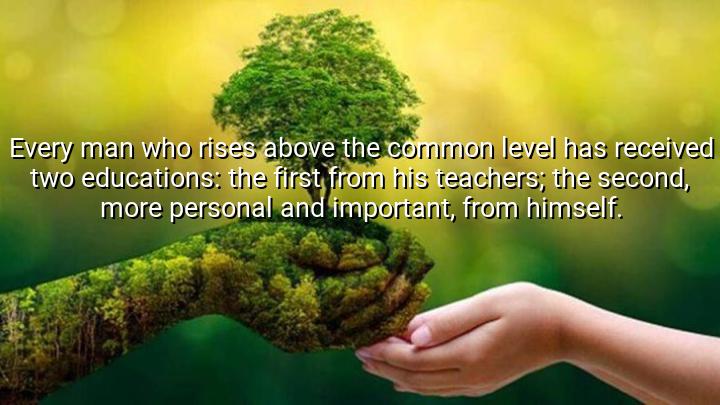




The quote by Edward Gibbon emphasizes that a person’s education is not limited to formal instruction from teachers but also involves a more personal, self-directed process. Gibbon suggests that every individual who rises above the common level benefits from two forms of learning: the structured guidance of formal education and the independent exploration and reflection of self-education. The second, personal education, is often more impactful because it reflects one’s initiative, curiosity, and commitment to growth.
Gibbon highlights the importance of self-discipline and personal responsibility in intellectual development. While teachers provide knowledge, frameworks, and mentorship, it is the individual’s own effort to question, apply, and expand on what they learn that truly shapes their mind and character. This personal engagement transforms knowledge into meaningful wisdom and enables individuals to excel beyond the ordinary.
The origin of this quote comes from Gibbon, a historian of the 18th century, known for his monumental work The History of the Decline and Fall of the Roman Empire. Gibbon himself was largely self-educated in philosophy, history, and classical literature, reflecting his belief in the transformative power of personal study alongside formal education. His experiences demonstrate that true intellectual achievement often depends on self-motivation and independent inquiry.
In essence, Gibbon’s quote underscores that education is a dual process: structured guidance from teachers and proactive self-learning. By combining these two forms, an individual can rise above mediocrity, cultivate deep knowledge, and achieve a level of personal and intellectual excellence that formal instruction alone cannot provide.

AAdministratorAdministrator
Welcome, honored guests. Please leave a comment, we will respond soon