

He alone is free who lives with free consent under the entire guidance of reason.
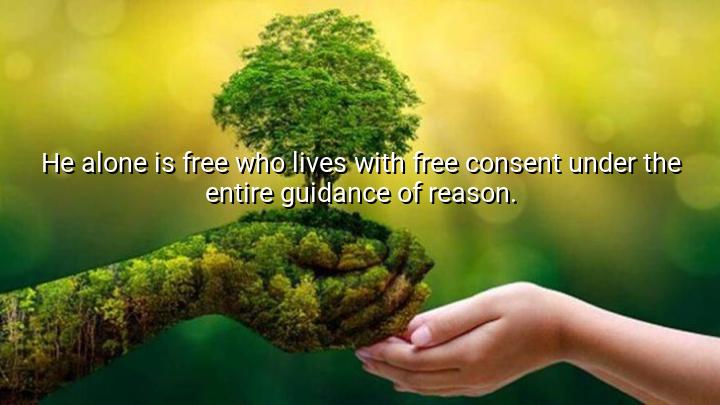




In this quote, Baruch Spinoza defines freedom not as the absence of external constraints, but as the ability to live in alignment with reason. According to Spinoza, true freedom comes from living with free consent—the voluntary choice to follow reason rather than being driven by emotions or external forces. He suggests that a person who lives according to their rational understanding of the world is truly free, as they are not controlled by irrational impulses or societal pressures.
Spinoza’s view of freedom is rooted in his philosophical system, where he argues that human beings are part of the natural world and subject to its laws. True freedom, for him, is not about having the ability to act without restriction, but about understanding the laws of nature and aligning one's actions with those principles. By using reason as a guide, an individual can make choices that are in harmony with both their nature and the world around them, leading to a life of self-mastery and fulfillment.
The idea of living with free consent under reason also implies self-determination—the ability to act consciously and deliberately rather than being at the mercy of unconscious desires or external influence. In Spinoza’s view, freedom is about achieving clarity and control over one’s thoughts and actions. It is through understanding and following reason that one becomes liberated from the limitations imposed by unchecked emotions or irrational beliefs.
Ultimately, Spinoza's quote highlights the relationship between freedom and reason. It suggests that the path to true freedom is not through escaping constraints, but through understanding the world with rational clarity and making choices in accordance with that understanding. Reason, for Spinoza, is the key to unlocking freedom, as it allows individuals to live in harmony with themselves and the world, achieving inner peace and autonomy.

DTNguyen Ngoc Doan Thuy
I admire the philosophical clarity here, but I can't help but think about how this contrasts with modern ideas of freedom—like freedom of expression or economic freedom. Is Spinoza saying that those don't matter unless they're chosen rationally? If so, that really challenges the way we define liberty today. I'd love to hear how this view fits into contemporary debates about freedom versus security, or individual rights versus collective responsibility.
BNTran Huynh Bao Ngoc
Does Spinoza exclude children or those with cognitive disabilities from this concept of freedom? It seems harsh if freedom only belongs to those who can reason at a high level. What about people guided by love, tradition, or faith—are they considered unfree? This feels a bit elitist in tone, even if it's intellectually rigorous. I respect the ideal, but I question whether it's fair or applicable to the diversity of human experience.
MNMai Ngoc
Reading this, I feel a strange kind of motivation. It’s like Spinoza is calling us to take full responsibility for our actions, to examine our motives constantly, and to reject passivity. But that’s exhausting, isn’t it? Can we ever live completely guided by reason without burning out or losing spontaneity? Maybe freedom isn’t an all-or-nothing state but more of a spectrum. What would Spinoza say to someone who values intuition just as much?
TTLe Thuy Trang
Spinoza's idea sounds empowering, but I wonder—what exactly counts as 'reason'? Different cultures and people reason differently based on their experiences and values. Is he referring to a universal rationality or something more personal? And what about those who are educated in flawed systems—can they still claim to be free if their reasoning is based on misinformation? I feel like this opens a whole debate about the reliability of our own minds.
TNTuan Nguyen
This statement makes me reflect on how often my decisions are shaped by societal pressures rather than reason. Can anyone truly live with 'free consent' in a world dominated by media manipulation, peer expectations, and economic necessity? It feels like Spinoza is setting a bar for freedom that’s incredibly high, maybe even unreachable for the average person. Is this an ideal to strive for or just a philosophical abstraction?