

Compassion alone stands apart from the continuous traffic between good and evil proceeding within us.
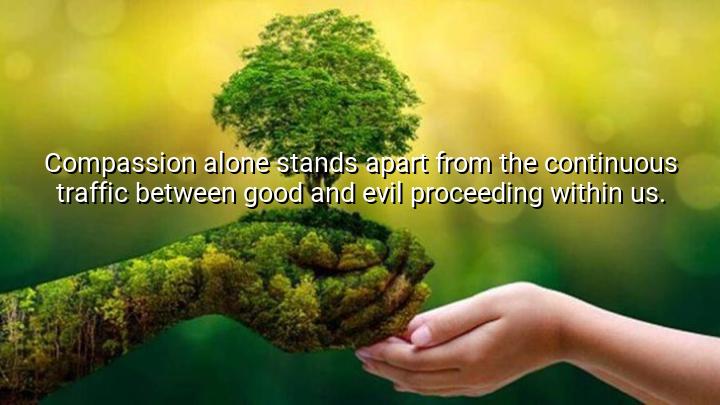




The quote "Compassion alone stands apart from the continuous traffic between good and evil proceeding within us" by Eric Hoffer highlights the unique, unifying nature of compassion in the midst of the moral struggles that occur within individuals. Hoffer, a philosopher and social thinker, suggests that compassion is the only quality that transcends the internal battle between good and evil that everyone experiences. While human beings often struggle with moral dilemmas, compassion remains a force that exists above this duality, providing a source of empathy and understanding.
Hoffer's quote points to the idea that within each person, there is an ongoing conflict between the good and evil impulses. These moral contradictions often define human behavior and choices, as we constantly navigate between self-interest and selflessness. However, compassion is portrayed as something more constant and pure, rising above this internal conflict. Unlike other emotions or actions, which may fluctuate between positive and negative, compassion provides a steady, non-judgmental presence that offers healing and connection.
The idea that compassion stands apart from the moral conflict suggests that it is not bound by the typical duality of human nature. Compassion does not depend on right or wrong but is instead rooted in a deep understanding of human suffering and a desire to alleviate it. Hoffer may be suggesting that through compassion, we can achieve a sense of moral clarity and spiritual peace, as it transcends the subjective judgments that often divide good from evil.
Ultimately, Hoffer’s statement encourages us to embrace compassion as a force that can guide us toward more harmonious interactions, free from the limitations of moral judgment. It speaks to the universality of compassion, showing that while everyone is caught in the internal struggle of good versus evil, it is compassion that allows us to rise above and truly connect with others in a meaningful way.

DNBui Dinh Nghia
This quote made me pause. If compassion exists outside the good vs. evil framework, does that imply it's not concerned with outcomes or moral calculations? Is it more about presence and emotional recognition than about choosing sides? That makes me wonder—could cultivating compassion in ourselves help quiet that inner turmoil between right and wrong? Or is that an overly romantic view of what compassion actually is?
HMTran Hung Manh
Hoffer’s idea suggests that compassion has a kind of purity that other moral forces lack. But does that mean it’s always the right choice, even when justice or fairness might demand something harsher? I struggle with this—can compassion ever conflict with accountability? What happens when being compassionate means allowing someone to escape the consequences of their actions? Where’s the balance between mercy and justice?
VAVan Anh
This makes me think: is compassion more of a passive observation, or is it an active force that disrupts the usual cycle of moral decision-making? If it stands outside the conflict between good and evil, maybe it offers a third path entirely—one based on empathy rather than ethics. But is that sustainable in a world where decisions often require judgment? Can compassion alone guide us through complex moral dilemmas?
LLindzy
I find this quote both beautiful and puzzling. If compassion truly stands apart, does that mean it's immune to our selfish impulses or moral conflicts? That would make it incredibly rare and powerful. But in real life, don’t people often show compassion selectively—based on bias, guilt, or even self-interest? I’d love to hear thoughts on whether true compassion is unconditional or if it, too, gets entangled in moral compromise.
MDHa My Dung
This quote really intrigues me—could it be that compassion operates on a different moral plane altogether? If so, what makes it so unique that it isn't influenced by the internal struggle between right and wrong? I wonder if Hoffer is suggesting that compassion is a kind of spiritual constant, not a product of reasoning or judgment. Is it possible that compassion is our purest instinct, free from the dualities that shape most human behavior?