

We are least open to precise knowledge concerning the things we are most vehement about.
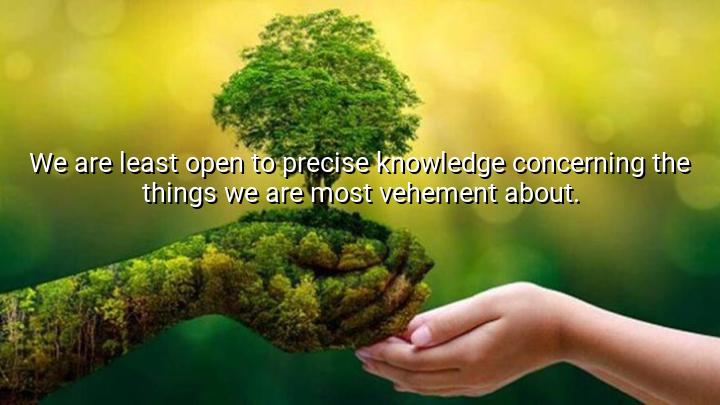




The quote by Eric Hoffer, "We are least open to precise knowledge concerning the things we are most vehement about," emphasizes the human tendency to resist objective understanding when it challenges strongly held beliefs or passions. Hoffer, an American philosopher and social commentator, was known for his insights into human behavior, mass movements, and the psychology of conviction. Here, he points out a common cognitive bias: intense emotions or fervent opinions can cloud our willingness to engage with facts or nuanced perspectives.
Hoffer suggests that when people feel strongly about a topic—whether political, religious, or social—they often prioritize their emotional commitment over rational analysis. This can lead to selective acceptance of information, ignoring evidence that contradicts their preconceptions. The quote underscores the difficulty of achieving true understanding when personal passion interferes with open-minded inquiry.
This observation aligns with Hoffer’s broader work on the psychology of mass movements and individual thought. He believed that extreme enthusiasm or fanaticism can inhibit critical thinking, making people resistant to knowledge that does not fit their worldview. Recognizing this tendency is a step toward cultivating intellectual humility and a more balanced approach to learning.
Historically, Hoffer wrote during the mid-20th century, a period marked by ideological conflict and social upheaval. His insights into human behavior and belief systems remain relevant today, reminding us that strong emotions and convictions can be both motivating and blinding. By highlighting the tension between vehemence and knowledge, Hoffer encourages reflection on how to pursue truth without being hindered by our own biases.

AAdministratorAdministrator
Welcome, honored guests. Please leave a comment, we will respond soon