

Change alone is unchanging.
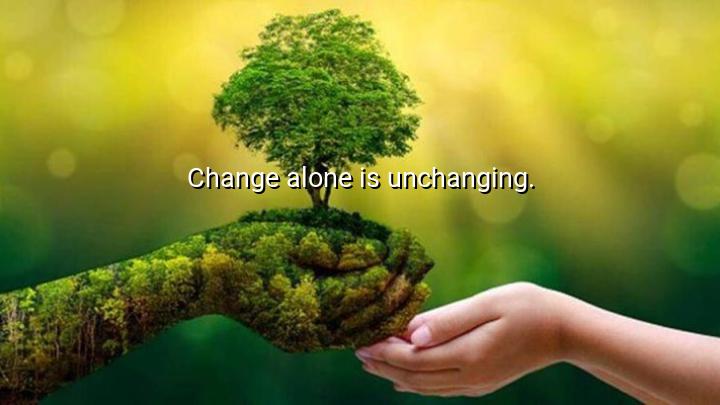




The quote "Change alone is unchanging" by Heraclitus reflects his philosophy that change is the fundamental constant of life. Heraclitus, a pre-Socratic Greek philosopher, believed that the universe is in a constant state of flux, and that nothing stays the same. According to him, the only true constant in the world is change itself. Everything in existence is subject to transformation, and even what seems stable or permanent is in fact undergoing subtle changes over time.
Heraclitus is often associated with the concept of the unity of opposites, where he posited that all things exist in a state of constant conflict and balance. For example, life and death, creation and destruction, are interconnected and continually shifting. By stating that change alone is unchanging, he is emphasizing the paradox that, while everything is in motion and subject to transformation, change itself remains the only constant force in the universe.
This idea challenges the human tendency to seek stability or permanence, suggesting that rather than resisting change, we must learn to embrace it as the only constant aspect of existence. In Heraclitus’ view, change is not something to be feared but rather an essential part of life that enables growth, adaptation, and progress. It is through change that life continues to evolve and find new forms.
Ultimately, the quote serves as a reminder of the inevitable and unceasing nature of change in both the natural world and human existence. Heraclitus invites us to accept the fluidity of life, recognizing that it is the very process of change that shapes and defines our experience of the world.

TNLam Tam Nhu
This statement almost feels like a warning to let go of control. It makes me think—if we can’t stop change, is our job to adapt or to evolve? Are those the same? And if change is guaranteed, what separates growth from chaos? It’s such a small quote, but it brings up big questions about agency, destiny, and resilience. How do you live wisely when everything’s in motion?
LALan Anh
I see this quote echoed in everything from nature to technology. But if change governs everything, how do institutions, traditions, or relationships survive? Aren’t some things meant to endure? Or are they just slower to change? Heraclitus makes me wonder whether permanence is just an illusion—a comforting story we tell ourselves in a world that never stops shifting.
HLBui Hai Long
What I find powerful about this quote is how it invites acceptance. If change is the rule, not the exception, maybe resisting it only causes more suffering. But then again, where does intentionality come in? If we just surrender to change, do we become passive? Or is there a way to embrace change while still steering our lives with purpose?
TLQuang Thinh Luong
This quote hits me differently depending on where I am in life. Sometimes it feels like a comfort—especially when I’m stuck or going through pain. But other times, it’s a source of anxiety. Is there anything we can actually rely on if everything changes? Can love, truth, or even memory survive in a universe defined by impermanence? Or is change itself the foundation of all those things?
THtanh hyunh
Heraclitus captures something deeply unsettling but also liberating. If everything is always in flux, does that mean identity, relationships, even values are constantly evolving too? I find that both freeing and terrifying. How do we develop a sense of self or purpose when nothing stays the same? Or maybe it’s in adapting to change that we discover who we really are?