

God is day and night, winter and summer, war and peace, surfeit and hunger.
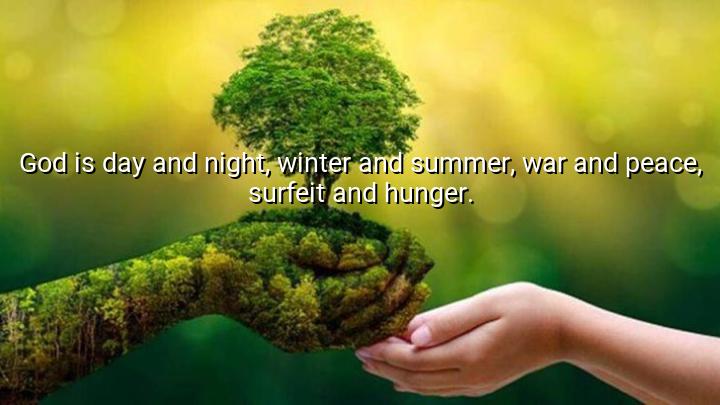




The quote by Heraclitus, "God is day and night, winter and summer, war and peace, surfeit and hunger," reflects his philosophical view on the unity of opposites in the universe. Heraclitus, a pre-Socratic Greek philosopher, believed that everything in the world is in a constant state of flux and that the balance between opposites is essential to understanding the nature of God and the universe. In this quote, he suggests that God embodies all aspects of life, both the contradictory and the complementary, showing that divinity encompasses everything, from the extremes of suffering to the heights of joy.
Heraclitus emphasizes the idea that God is not just a force of good or light but also encompasses darkness, conflict, and hardship. By including opposites such as war and peace and hunger and surfeit, he points to the natural and spiritual equilibrium that exists between all contradictions. According to Heraclitus, these dualities are not separate but part of a greater whole, where each is needed to understand the other. God, in this view, is the force that transcends these extremes, binding them together in a harmonious and ever-changing balance.
The origin of this quote comes from Heraclitus' belief in the Logos, the rational principle governing the cosmos. Heraclitus is known for his doctrine of becoming and the idea that everything is in constant flux. His thoughts were rooted in the understanding that unity exists in diversity, and the divine is present in all aspects of the world, including both its light and its darkness. By acknowledging both war and peace as aspects of God, Heraclitus presents a view of the divine as an all-encompassing force that moves through every part of existence.
Ultimately, the quote emphasizes the holistic nature of God and the universe, where everything, including opposites, is part of a unified whole. Heraclitus' view challenges us to accept that both good and bad, joy and suffering, are integral parts of the human experience and of divine existence. It invites reflection on the interconnectedness of all things and the belief that through contradictions, a deeper truth and balance can be found.

AAdministratorAdministrator
Welcome, honored guests. Please leave a comment, we will respond soon