

CEOs must go beyond working with policy-makers on new regulatory frameworks. They must also commit to the principle that success cannot be measured by profitability and growth alone.
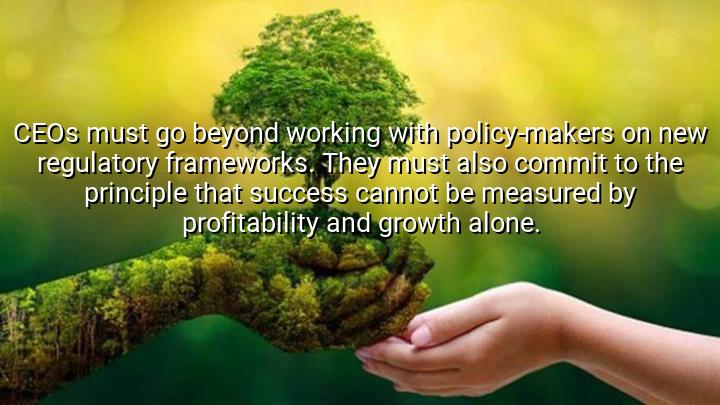




The quote "CEOs must go beyond working with policy-makers on new regulatory frameworks. They must also commit to the principle that success cannot be measured by profitability and growth alone." by Pierre Nanterme emphasizes a broader view of leadership in business. Nanterme argues that while profitability and growth are essential for a company’s success, they are not the sole indicators of a company's long-term value or impact. CEOs, according to Nanterme, must also focus on social responsibility, ethical practices, and sustainable development, working alongside policy-makers to create a framework that fosters not just financial gain but also societal well-being.
The quote challenges the traditional notion that business success is only about maximizing profit and growing at all costs. Nanterme suggests that true leadership involves a deeper commitment to ethical behavior, fairness, and a balance between economic success and positive social impact. By collaborating with policy-makers, CEOs can help shape regulations that ensure companies contribute to the broader good, rather than only focusing on short-term financial gains.
Nanterme’s message also points to the changing expectations of business leaders in an increasingly interconnected world. Today’s CEOs are held to higher standards, where their leadership is not solely judged by financial metrics but also by their ability to lead companies that contribute positively to society and the environment. This perspective calls for a more holistic approach to success—one that takes into account the long-term consequences of business practices.
The origin of this quote comes from Pierre Nanterme, the former CEO of Accenture, a global professional services company. Nanterme’s leadership style emphasized a commitment to innovation, diversity, and corporate responsibility. His perspective on business ethics and the need for leaders to adopt a broader definition of success reflects his vision for a more sustainable and responsible corporate world. This quote encapsulates his belief in the evolving role of CEOs as stewards not just of financial outcomes, but of societal and environmental well-being.

DKDuy Khac
I’m struck by the challenge of measuring success beyond numbers. What tools or metrics exist to evaluate impact on society and the environment effectively? How can CEOs communicate these broader achievements to stakeholders in a compelling way? This perspective suggests a future where qualitative and quantitative measures coexist in business evaluation.
LDluat day
This quote makes me think about the role of policy-makers and regulatory frameworks in shaping business behavior. How can governments and industry leaders collaborate to create incentives for responsible business practices? Are current regulations sufficient to encourage CEOs to adopt a holistic view of success, or is more innovation needed?
CTNguyen Chi Trung
Nanterme’s insight raises a debate about the purpose of business in society. Should companies prioritize broader social good even if it impacts short-term profits? How do CEOs balance competing demands from customers, employees, communities, and shareholders? This quote invites reflection on the evolving definition of corporate success.
HFhi Fang
Reading this, I’m curious about the practical steps CEOs can take to demonstrate commitment to principles beyond growth. Does this involve corporate social responsibility programs, changes in governance, or cultural shifts within organizations? How can leaders ensure these efforts are genuine and not just ‘greenwashing’ or PR?
MMMdnfnmnfnfn Mdnfn
This statement highlights a shift in corporate leadership priorities. Are CEOs prepared to embrace this expanded role, and what challenges might they face? How do investors and shareholders react to measures of success beyond profitability? It’s important to explore how stakeholder expectations are evolving and how companies can align with these changes.