

But there comes a moment in everybody's life when he must decide whether he'll live among the human beings or not - a fool among fools or a fool alone.
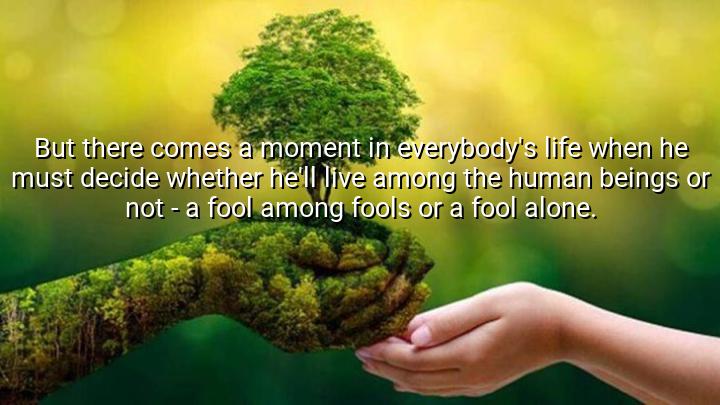




The quote "But there comes a moment in everybody's life when he must decide whether he'll live among the human beings or not - a fool among fools or a fool alone." by Thornton Wilder explores the critical decision individuals face when confronting the complexity of human relationships. Wilder suggests that at some point in life, a person must choose whether to conform to societal norms and live among others, even if it means being surrounded by foolishness, or whether to isolate themselves in order to preserve their own integrity, potentially becoming a "fool alone".
Wilder’s words reflect the dilemma many people face in deciding whether to engage in social life, with all its flaws and compromises, or to withdraw and remain independent but potentially lonely. The phrase "a fool among fools" suggests that by conforming, a person may lose their sense of individuality, while "a fool alone" implies the loneliness that comes from remaining true to oneself outside of society's expectations. The conflict between conformity and independence is central to Wilder’s exploration of self-awareness and personal choices.
The quote also speaks to the tension between individuality and social belonging. For many, the need to fit in and be accepted by others can conflict with the desire to live authentically. Wilder captures the emotional and philosophical struggle of deciding whether to compromise one’s values for the sake of companionship, or to stand apart, risking isolation but retaining personal freedom.
The origin of this quote comes from Thornton Wilder, an American playwright and novelist, best known for works like Our Town and The Bridge of San Luis Rey. Wilder’s writings often examine themes of individualism, society, and the human condition. This quote reflects his deep understanding of the complexities of human life and the difficult decisions individuals face in navigating personal identity and social interaction.

QMQuang Mom
This quote makes me reflect on historical figures who chose to stand alone against prevailing wisdom. Were they fools or visionaries? How does society’s labeling of ‘foolishness’ change over time? Wilder’s words seem to underscore the transformative potential of choosing the solitary path, even at great personal cost.
NTTai Nguyen Tien
Wilder’s observation raises a question about the nature of societal norms. Who decides what makes someone a fool, and how much of that is subjective or cultural? Could this quote encourage skepticism toward majority opinions and inspire embracing individuality despite external judgments?
THThao Hoang
This quote prompts me to think about the role of wisdom and folly in human experience. Can being ‘a fool among fools’ sometimes be the safer choice, or does it perpetuate ignorance? Conversely, does solitude provide a space for deeper insight, even if misunderstood by others? It’s a powerful meditation on social dynamics and self-awareness.
MTMo Tam
Reading this, I wonder how people navigate moments when they feel isolated for their beliefs or actions. Does embracing solitude as a ‘fool’ lead to growth and self-discovery, or does it risk alienation and despair? Wilder’s words seem to challenge us to consider what kind of ‘fool’ we are willing to be.
KMKhang Mu
This statement highlights the tension between individuality and belonging. Is it possible to be authentic while living among others without feeling like a fool? How do social pressures influence our decisions to conform or stand apart? It raises questions about the cost of nonconformity and whether society truly values independent thinking.