

Hope, like faith, is nothing if it is not courageous; it is nothing if it is not ridiculous.
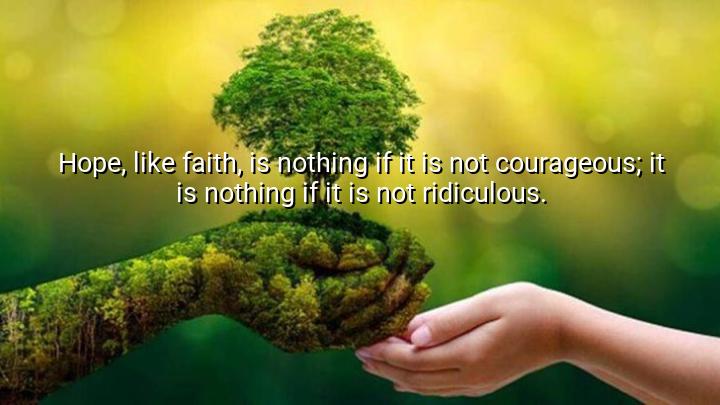




In this quote, Thornton Wilder suggests that hope, like faith, is only meaningful if it is accompanied by courage and the willingness to embrace the ridiculous. He argues that true hope is not passive or conventional; it requires boldness and the ability to hold onto belief even when circumstances seem impossible or irrational. Wilder emphasizes that hope, when not challenged by adversity or doubt, lacks depth and power. It must be daring, perhaps even seeming foolish to others, to truly have an impact.
Wilder’s statement reflects the idea that hope and faith are not just abstract feelings but active, dynamic forces that require strength to maintain. If hope does not push us to go beyond our comfort zones, to take risks, or to fight against seemingly insurmountable odds, it lacks substance. Courage gives hope its vitality, making it something that motivates action and perseverance, even when the situation appears hopeless.
The origin of this quote comes from Wilder's work as a playwright and novelist, where he explored themes of human resilience, doubt, and belief. His famous works, like Our Town and The Skin of Our Teeth, often delve into the human capacity to hold onto hope and faith in the face of life's uncertainties and challenges. This quote embodies Wilder’s belief that hope becomes powerful when it embraces the absurdity of life and the need to move forward despite overwhelming odds.
Wilder’s message encourages people to approach hope with a sense of courage and adventure, recognizing that it requires boldness and sometimes a willingness to act in ways that others might deem foolish or unrealistic. The most profound forms of hope are those that are unwavering, even when they seem ridiculous, because they fuel the perseverance needed to overcome the challenges we face.

AAdministratorAdministrator
Welcome, honored guests. Please leave a comment, we will respond soon