

And if you don't believe the sun will rise, stand alone and greet the coming night in the last remaining light.
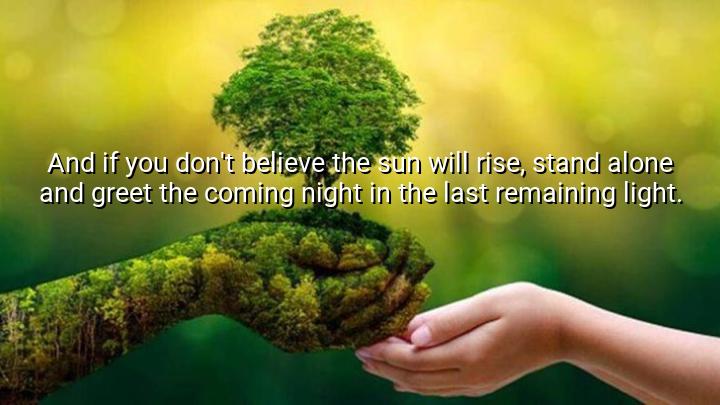




The quote "And if you don't believe the sun will rise, stand alone and greet the coming night in the last remaining light" by Chris Cornell reflects a message of hope, resilience, and self-reliance in the face of doubt or despair. Cornell suggests that even in moments of uncertainty or darkness, when one might feel uncertain about the future, there is value in standing alone and embracing the present moment. By focusing on the remaining light—symbolic of hope, courage, or clarity—Cornell encourages individuals to face difficult times with strength and a sense of purpose, even if they feel disconnected or isolated.
Chris Cornell, an American musician and lead singer of bands like Soundgarden and Audioslave, was known for his powerful voice and thought-provoking lyrics, often exploring themes of struggle, emotional conflict, and personal growth. His words here reflect his own struggles with mental health and the emotional challenges of life. The quote can be seen as an expression of his own belief in endurance and the power of self-awareness during times of adversity.
The phrase "stand alone and greet the coming night" underscores the theme of solitude and acceptance. It suggests that when one faces difficult or dark moments, it is possible to confront them head-on, standing firm in the face of adversity. This idea of greeting the night instead of avoiding or fearing it reflects the acceptance of life’s uncertainties and the ability to find peace even in times of darkness or struggle.
Ultimately, Cornell’s quote serves as a reminder that hope and strength can be found, even in the most challenging moments, by embracing solitude and taking ownership of our emotional journey. It emphasizes the importance of self-reliance and finding the courage to stand tall, even when the future feels unclear. Through this acceptance of the present, one can hold on to the belief that better days, symbolized by the rising sun, are always possible.

THTan Huy
I can’t stop thinking about how this quote frames solitude—as something not only inevitable but sacred. To stand alone, in doubt, yet still face the darkness... it’s tragic but courageous. Do we give enough space in our culture for this kind of silent, internal endurance? It’s not the loud fight—it’s the quiet decision to stay present, even without guarantees. That feels like a rare kind of strength.
NMDung Nguyen Manh
Cornell’s words feel like a challenge and a comfort at once. If you can't believe in better days, can you at least meet the darkness honestly? It’s oddly empowering. But I also wonder if this was written from a place of depression. How do we differentiate between existential bravery and emotional exhaustion? Does this quote encourage healing, or does it acknowledge that sometimes healing isn’t yet possible?
MNPhan Thi Minh Nha
There’s a poetic stoicism in this quote that really stays with you. It raises a question I keep circling: when all optimism is stripped away, what’s left? Is there still beauty in the final light, even if we expect only darkness to follow? Maybe this line is about those fragile, in-between moments where we confront both the fear of what’s coming and the weight of what’s already been.
PHTan phat Huynh
This quote resonates with me as someone who’s struggled with cycles of hope and hopelessness. It seems to capture the exact moment when faith falters but you still show up for life anyway. I think it speaks to a kind of spiritual discipline, even when you’ve lost belief. Is Cornell advocating for presence, even in the darkest times? Or is this more about resignation than resilience?
HTHuong Thien
The imagery here is so powerful. It makes me think of people who’ve been through deep loss or depression—when it feels like there’s no sunrise in sight. But the idea of ‘greeting the night’ suggests a conscious, maybe even brave, choice to face the unknown. Is this quote a call for acceptance, or a subtle expression of surrender? I’d love to know how others interpret the emotional tone here.